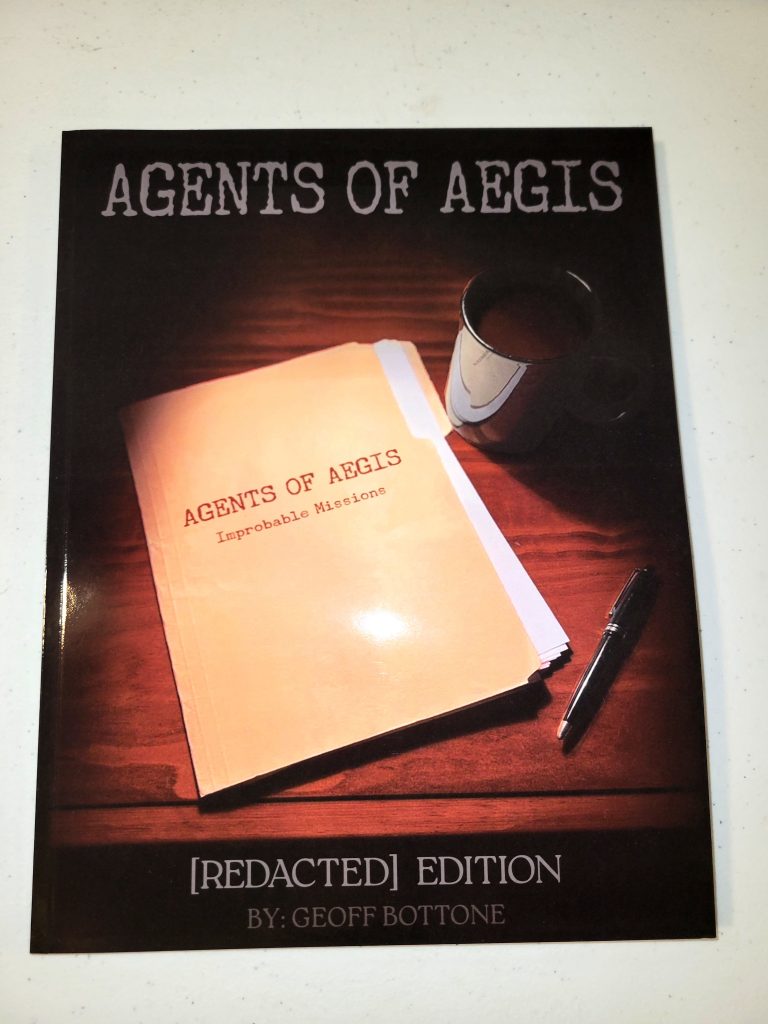
My mission, which I chose to accept, was to back the KickStarter for Agents of AGEIS [Redacted] Edition from GeoffQuest. I received several bonuses for backing this espionage RPG which I’ve been given permission to reveal now. Be wary, TALON agents are around every corner trying to steal your secrets.
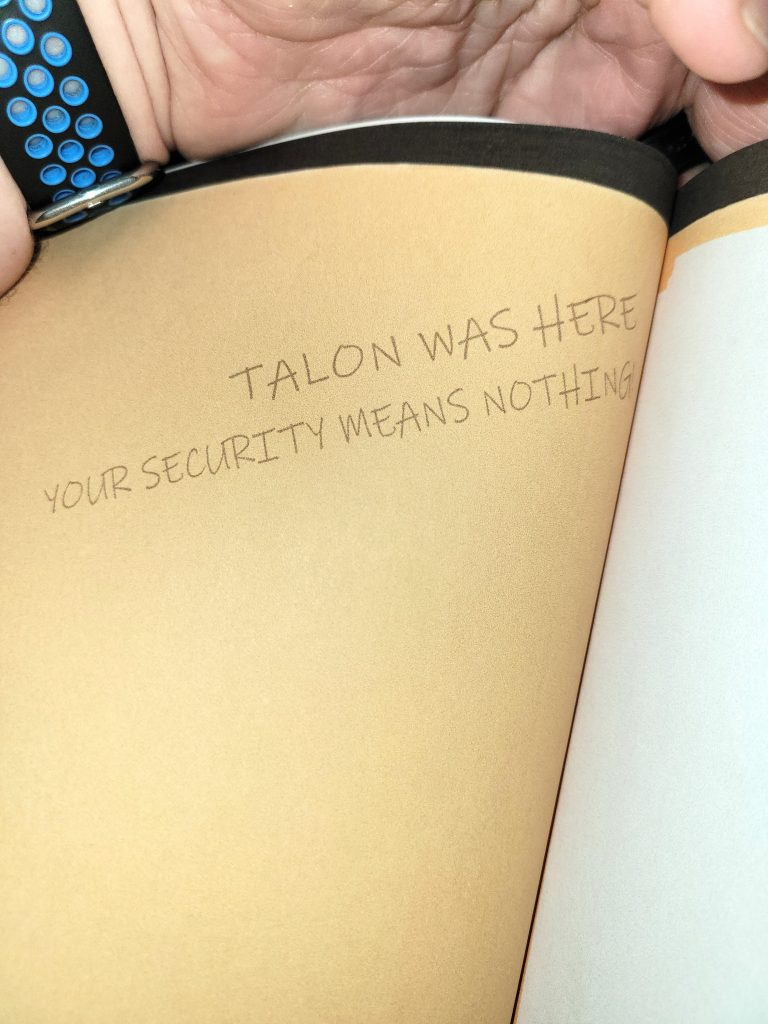
Agents of AGEIS [Redacted] Edition was released by the same small publisher that released Boldly Go! that I used in a previous Character Creation Challenge and uses a similar system. It was written by Geoff Bottone with the graphic design by Alia Hyman. Most of the art is black and white royalty free photos. Another proof that you don’t need AI slop to illustrate your books. For those of you purchasing the PDF, it’s only 8.26MB in size with an ISBN number of 978-1-7371457-9-7. The deadtree version (ISBN 2-370022-616684) of this softbound book has 96 pages with a color cover and black and white photos throughout. The format is like looking in a series of manila envelopes. An interesting inside joke is the handwritten notes by an infiltrator from TALON popping up in different locations of the book.
I was on a quest to search for these notes throughout the book.
The book has nine chapters, an introduction, appendix and index. The chapters include The Setting and the Meta, Core Rules, Vehicles, Base Creation, Character Creation, Assets, NPCs, TALON and The Play’s the Thing (GMs section). In the appendix is a random mission generator, base creation summary, character creation summary and some example sheets. This copy is a PoD from DriveThruRPG. I reviewed their PoD products here.
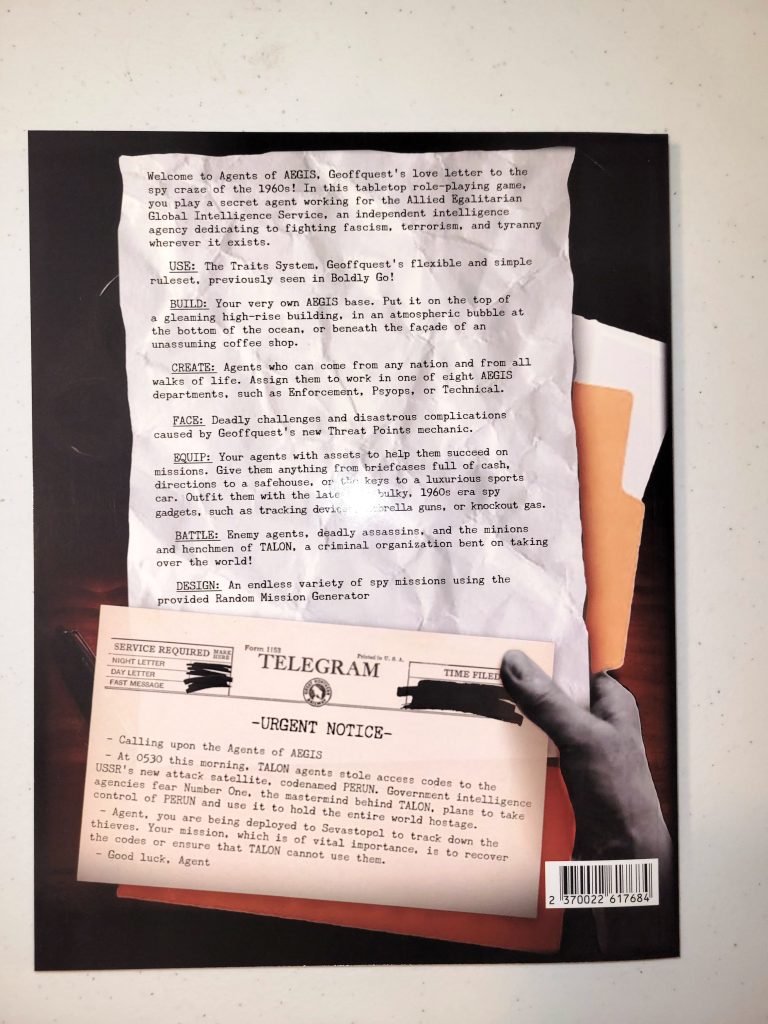
The back cover to Agents of AGEIS.
The basis of this game universe is the espionage adventures set in the 1960s similar to James Bond, Matt Helm, Derek Flint, Modesty Blaise, Cate Archer or Austin Powers. The players set up a base and build an espionage team for AGEIS (Allied Egalitarian Global Intelligence Service) which is a independent agency that was dedicated to fighting fascism, terrorism and tyranny across the globe. It kind of reminds me of the espionage comedy series Archer. Working with different governments, but not reporting directly to them. The default bad guys are TALON. A series of arms dealers that later switched to the goal of world domination.
Agents of AGEIS, like Boldly Go!, uses a dice pool system of D6s that they call the Traits System. A trait can come from the character, equipment, environment, etc. and can be positive or negative. When a player character attempts a task, they start with one D6. For each trait that they can justify to the Secretary (GM) they gain an additional die, up to six dice. Each roll of a 5 or 6 counts as a success. Depending upon the difficulty of the task, the number of needed successes can range from 2 (average) to 6 (almost impossible). The players also have Drama Points which can add additional dice or allow the player to manipulate the dice in the pool.
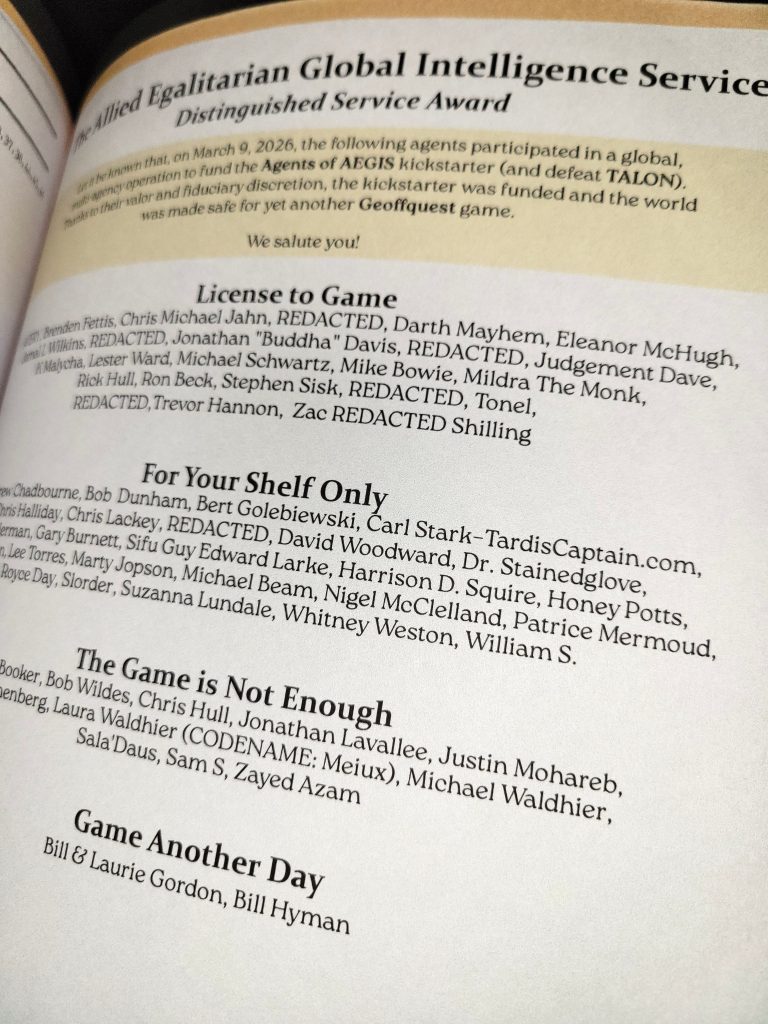
I’m getting smarter about adding my name to these thank you pages.
While going through the book I originally though that the term used for the GM was both Secretary and Director. But it turns out, the Director is an NPC used by the GM as the PCs handler. On page 59 the sentence ends on the page indicating that it would be continued on the next page, but I could not find where it was finished off at. From my first run through the book, this appeared to be the only editorial mistake. The mission generator looked really interesting. It gives you a series of prompts and lets the GM fill in the blanks.
Overall I’m very happy with backing Agents of AGEIS [Redacted] Edition and the physical book I received. While looking through this book I started wondering if I could run a one-shot at SaltCON. I could definitely use this for a future series of homebrew posts that I’m planning to release (more on that soon). I will be using this game in the 2027 Character Creation Challenge coming up in January.
Oh, before I let you guys go. A reader recently reached out to me in response to my Star Trek: Sky’s the Limit comic review. He was hoping that this special one-shot issue was finally available on digital format. I searched both Amazon and the IDW website with no success. But I was grateful to know that my past reviews are still being read.
Do you have any questions about the Agents of AGEIS [Redacted] Edition? Have you backed any Kickstarters lately? Tell me about it. This article is open for discussion on the TardisCaptain dot Com Discord server. You can also email me at Carl (at) TardisCaptain.com with any comments.
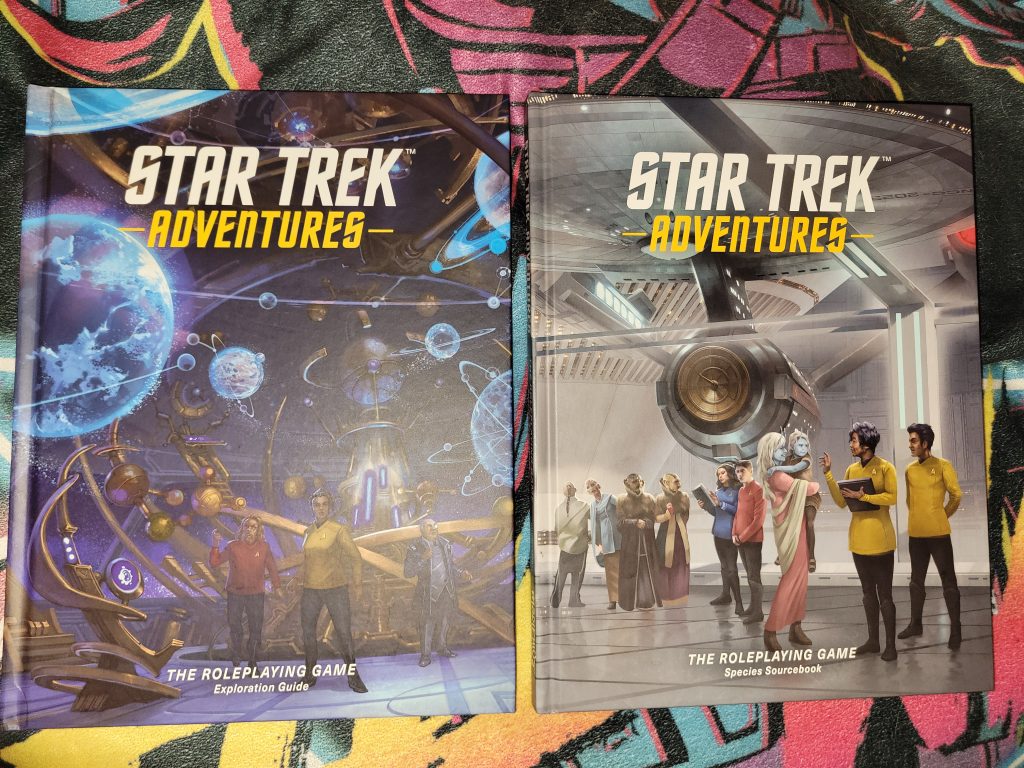
When I realized that I would have both books in my physical possession about the same time, I elected to review both in one blog post. As mentioned previously, if you buy a physical book from Modiphius on their website, they send you the PDF immediately. If you buy a deadtree version from another source, you can still send them a photo to Support@Modiphius.com and they will send you the PDF as soon as they have processed the ticket. This is usually done in a couple of business days and is very much appreciated.
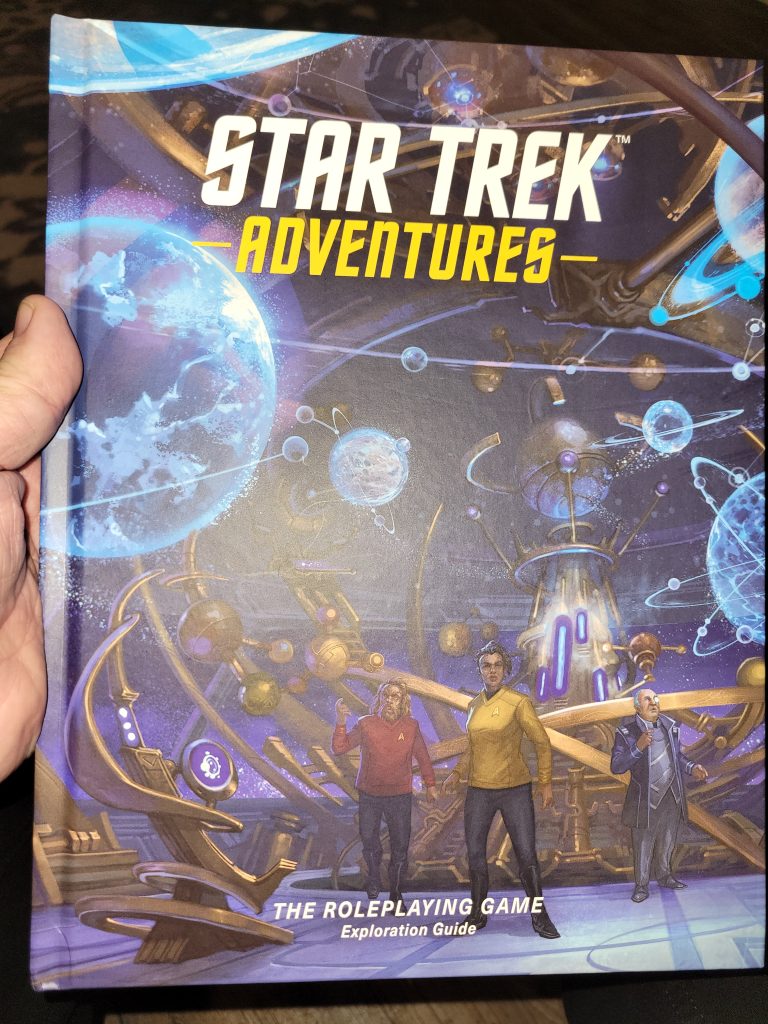
The cover to the STA2e Exploration Guide.
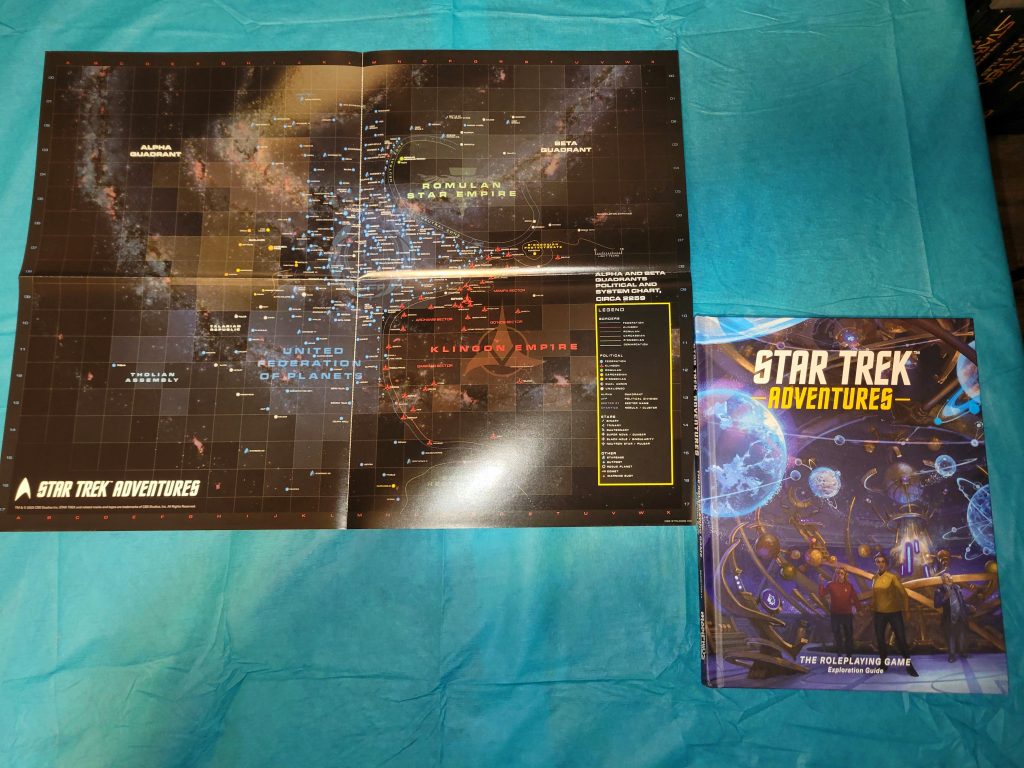
As mentioned above, the Exploration Guide was released by Modiphius in 2025. This hardbound book has 144 pages and includes a two sided poster map for the 23rd and 24th century (see photo below). These same maps are on the front and back interior covers. The ISBN number is 9-781802-812749 and the product number is MUH0142514. Inside on the credits you’ll find names such as Nathan Dowdell (system designer), Jim Johnson (Many hats including Project Manager). I’ve noticed that there are more writers and artists in the credits for these books than there was for the STA2e Technical Manual. These writers include Eric Campbell, Marieke Cross, Michael Dismuke, Nathan Dowdell, AJ Fox, Jim Johnson, Aaron M. Pollyea and Al Spader. The cover artist was Rodrigo Gonzalez Toledo (who also did the cover for the Technical Manual) with interior art by Erin Arik, Marc Bell, Carlos Cabrera, Andrew Clark, Elena Conte, Albert Cordero, Enoch Driscoll, Aurea Freniere, Toma Fiezo Gas (kewl name BTW), Andrew Jarvis, Vincent Laik, David Metlesits, Wayne Miller, Berenice Buniz, Dat Phan, Paolo Puggoioni, Armin Rangani, Vadim Sadovsky, Nicola Sivani, John Teska, Rodrigo Gonzalez Toledo, Angelos Vadeiros and CBS Studios. Someday I hope to see my kid with the art degree from the University of Utah in one of these credits.
A photo of the map with the Exploration Guide.
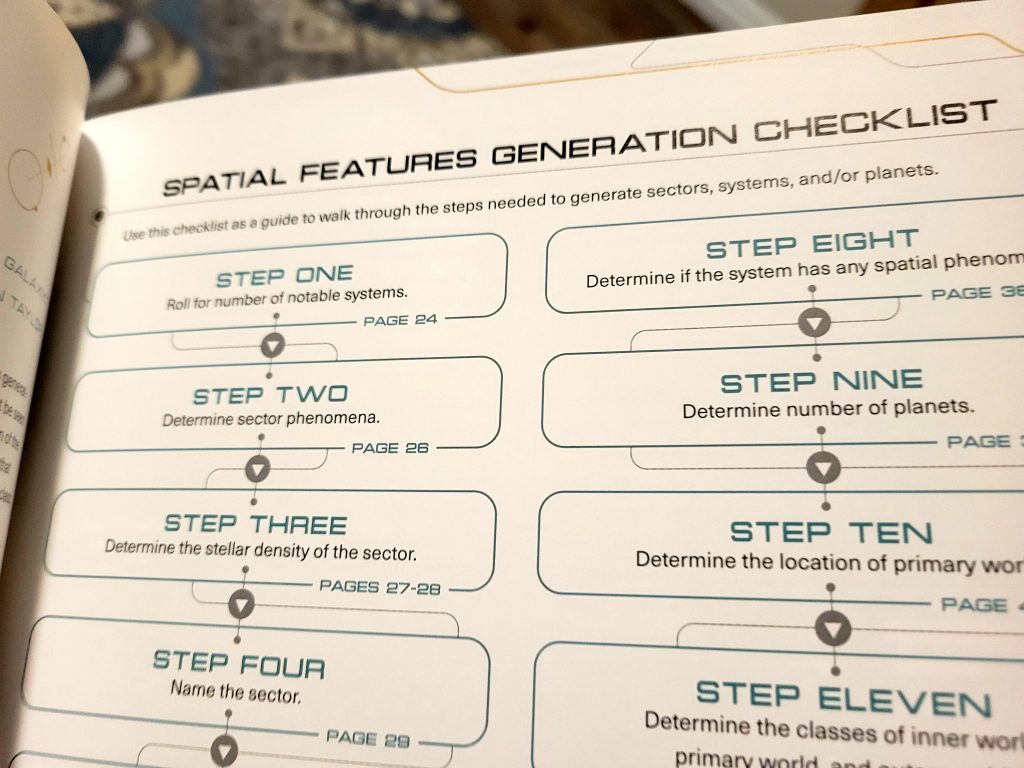
The contents of the book include an introduction and five chapters. These includes Supplemental Game Mechanics, Sector Generation, Star and System Generation, Planet Creation and Planetary Biomes. In the back of the book there is both an Index and a List of Tables. There are a lot of tables in this book which makes me happy. We also have flowcharts (with page numbers) that are similar to those in the STA2e Core Rulebook which made it soooooo much easier to read as compared to 1st edition. Proof that Modiphus listens to the fans of the game that provided them with feedback.
A partial sample of one of a flowchart found in the book.
The Independent Archeologist and Outpost Scientist (both of which we see a lot in Trek) are two new career paths that are available for characters. I had to giggle at one of the value suggestions for the archeologist that sounds like it could have been said by a man with a fedora and whip. There are also several possible career events and an interesting sidebar on the Officer Exchange program. A handful of new talents are also listed for players to use that fit the theme of this book. But one very interesting addition to the character creation is the Secret. This could be a secret value, trait or talent and would need to be coordinated between GM and player. New awards and honors are also provided for use by the GM. Now exploring is about observing and becoming aware of unknown things. There is an entire sub-chapter about how the different player attributes and departments can be used in spotting or revealing items during play. This is good as I’ve wondered about this in some of my past one-shots. The use of Challenges and Extended Tasks in exploration is also presented.
As noted in past reviews, I love how Star Trek quotes were utilized to give the book some flavor. Well this book also includes quotes from notable scientists. This made me smile. When talking about the various biomes that are present on the different worlds, the writers elected to provide a list of Star Trek episodes that matched those biomes. I will say that I was confused by The City on the Edge of Forever being recommended for the Forest biome or The Crossing for the Water biome. Various story seeds are also provided for each biome which may assist some GMs in planning out their adventures. I wonder what the pilot of the runabout was thinking in that image on page 119?
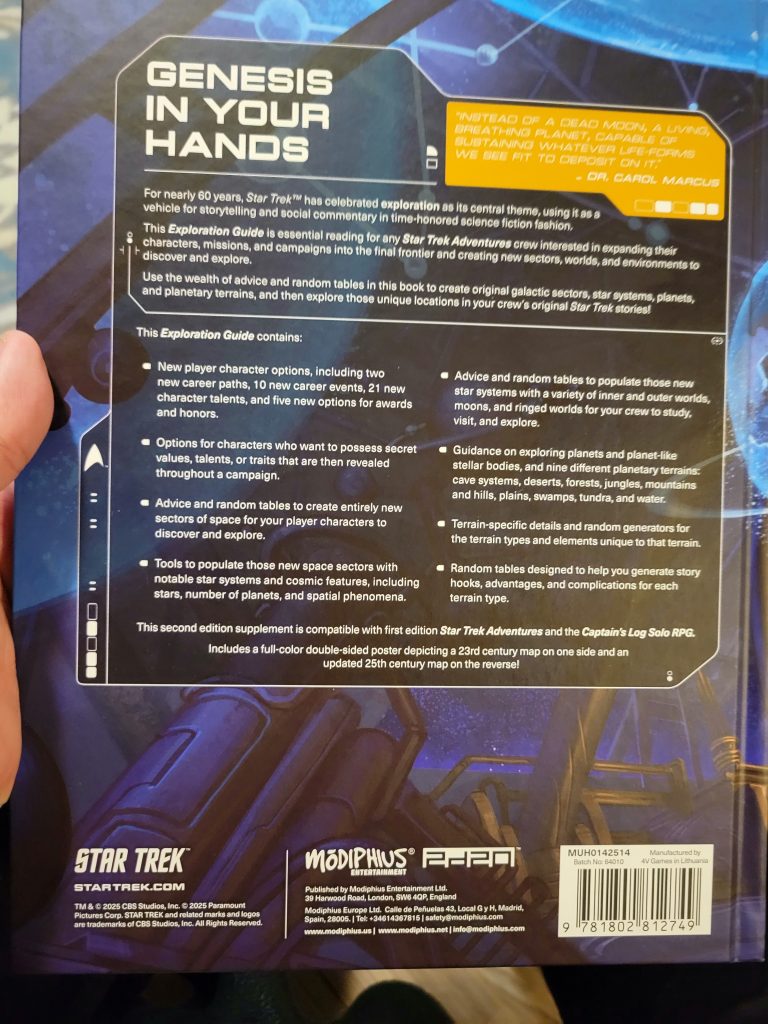
The back cover to the Exploration Guide.
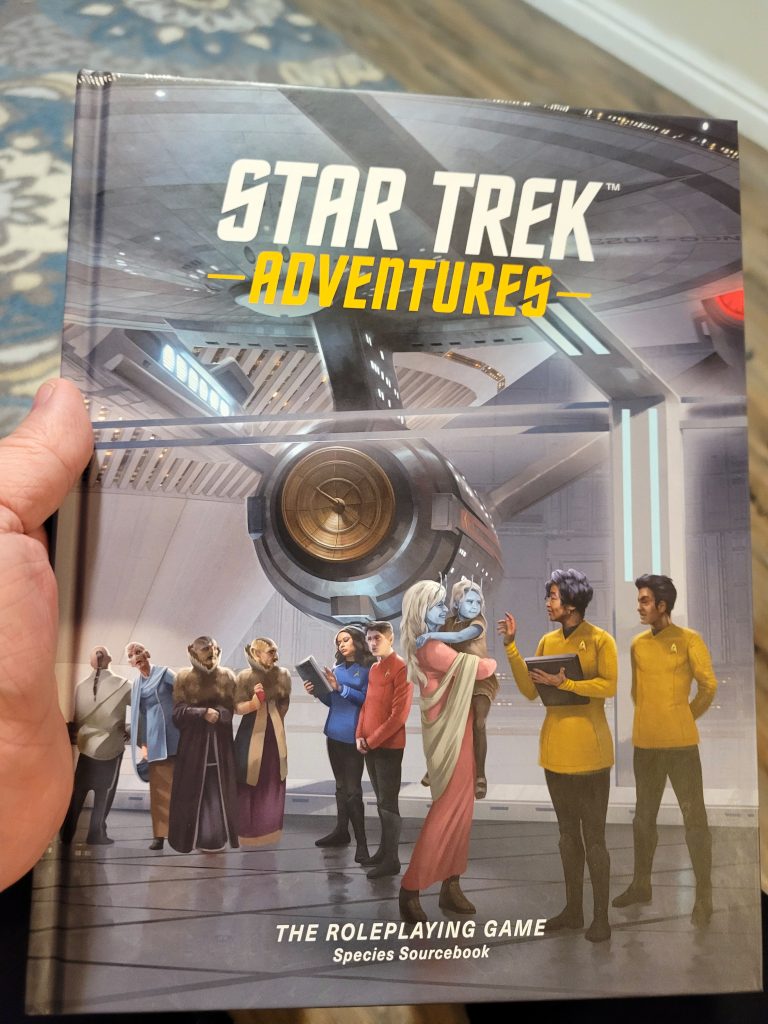
The cover to the Species Sourcebook.
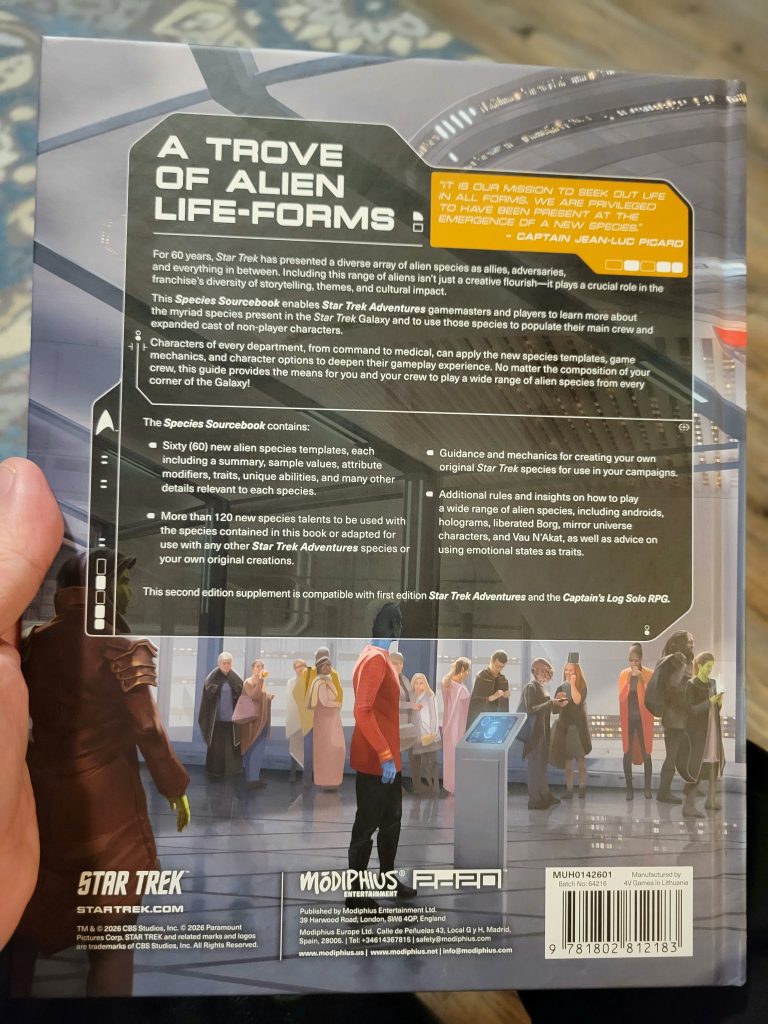
Currently the latest publication for STA2e is the Species Sourcebook. While the Exploration guide was a book primarily for GMs to create those strange new worlds, this book is the new life and new civilizations that can be used as possible player characters. Sixty new alien templates are made available in this book with entries from The Original Series all the way to Section 31. There are some species that may not be considered to the “good guys” available in this book, but that would help if a player wants a character that may be an exile or a cross-breed.
The ISBN number for this hardback book is 9-781802-812183 with a product number of MUH0142601. Inside there are 133 pages. The introduction is found at the start and the index at the end. And while there is only one chapter, there are a LOT of sidebars for different chapters species and talents (such as shapeshifting, breathing apparatus requirements or something from the IDW Star Trek comics). After all of these are presented, there is a section for GMs on how to create an original species. I can see myself using this for homebrewing from other Trek sources.
The cover for this book was provided by Paolo Puggioni. Some of the additional art credits include the Star Trek Online MMORPG. The talented wordsmiths mentioned above are all present in this publication. When I showed this book to my daughter with the art degree, she pointed out how much she loved the artwork for the Deltan (how the dress flowed over the character) and the Risian (the shading in the clothing that covered the figure and how it made the character stand out without the use of heavy lines.) She spent some time talking with me about the different styles in the book and what worked for her and what didn’t. I really wish I had been smart enough to write it all down or record it.
Don’t take the lack of photos or description on the Species Sourcebook to mean that I loved it any less than the Exploration Guide. Both books filled different niches within the Star Trek Adventures 2nd Edition RPG system and were very well thought out. Recently I was able to convince another GM into running 2nd edition as compared to 1st by my past reviews. If anyone is considering running or playing STA2e, I can’t recommend these enough.
I’m already trying to save my Quatloos for the next book. Jim Johnson has been giving hints about it on the Modiphius discord server. So far, my money is on a book based on the medical aspects we’ve seen in the different Star Trek shows. Is my guess the right one? I hope we will find out soon.
And one last thing before I wrap this up. Modiphius has a system set up to report typos in the various books. I found one in the STA2e core rulebook that I submitted to them. And they recently released the latest errata that contained my corrections. I was tickled to see that.
Did you have any questions about the Exploration Guide or the Species Sourcebook for Star Trek Adventures 2nd Edition? Ask me about it. This article is open for discussion on the TardisCaptain dot Com Discord server. You can also email me at Carl (at) TardisCaptain.com with any comments.
Some of you may be wondering why there was a kickstarter for a quickstart? The goal was to provide the internal art for the book and pay the artists for their work. Third Kingdom Games has made the pledge to not use AI generated graphics in their publications. And since that’s a subject very close to my heart, I had to back them. Besides the PDF, I received a print-on-demand from DriveThruRPG. I’ve reviewed some POD publications previously.
So the softcover book that I received in the mail has a full color cover and interior black and white art. Probably in a callback to the older RPG books that we use to collect. The ISBN number is 2370022620158 and the book has 50 pages. It was written by Todd Leback. The cover art is by Juan Ochoa with Perplexing Ruins and Dyson Logos providing some of the interior art. There are two sections for Players and GMs. Six short chapters for the players (The Basics, Character Classes, Gear and Gold, Magic, Adventuring and What Comes Next) and three for the GMs (Intro Adventure, Monsters and Treasure). One interesting note, the book measurements are slightly taller than other books. I took a photo of the Quickstart rules with the Basic Fantasy core rulebook which is standard sized.
Side-by-side comparison with a normal sized book both level at the bottom.
As a retro-clone, it might be easier to say what the differences are to the other publications that we are all well aware of. Bree-YARC uses Ancestry (aka race) as a Class just as it would back in the B/X days. In this quickstart there is only Humans, but they do have classes like Thief, Fighter, Cleric and Magic User. On DriveThruRPG, the publisher has been releasing PDFs of other Ancestries and Classes for free. These include the Dwarf, Goblin, Owlfolk and Tiefling. For the new Human classes they have Ranger, Bard, Berserker, Hexblade and Sorcerer. It is mentioned that more classes and ancestries will be presented in the Core Rulebook when it is released.
All characters have their 0-level HP that they roll before they obtain the 1st level HP+CON adjustment roll. Savings Throws use the older terminology (Wands, Breath Attack, etc.) but are calculated differently. There are skill checks that require meeting/beating a DC rating. Lawful, Neutral and Chaotic is the alignment system presented. XP bonuses are given for playing characters with lower ability scores instead of higher ability scores. Each class has their own special abilities and each character gets a Knack or special ability. It appears that this game is using Ascending Armor Class (thank you). There is Advantage/Disadvantage. Experience points for treasure is only earned when the party returns with it to a safe place. There are also opportunities to earn XP through exploring. Before a character moves up a level, they have to complete a certain amount of Downtime in a safe location. This could include item crafting, research, carousing, hiring, etc. And finally each character will have a Renown rating that represents their reputation in the game world. Whew.
The room descriptions in the intro adventure looked interesting. At a glance the GM knows what’s in the room with additional details described below the chart. This can include lighting, secrets, sounds, exits, etc. The monster stats are found in the adventure with the monster section mostly describing the stat description breakdown, morale conversion table, XP chart for creating monsters, etc. The treasure section describes the types of treasure and the value of a treasure horde.
The back cover.
Conclusion: When I first got the physical book, I wondered if I’d be happy backing this Kickstart campaign when I saw how thin it was. I had forgotten that it was just the quickstart book. But I wasn’t too worried because the support levels were very reasonable for a publication of this size. I really dislike the Kickstart campaigns where they want a bunch of money for an unverified product. The smaller prices usually entice me to pull the trigger. However, once I started reading this book for this review, it reminded me why I had backed their earlier Kickstart campaigns. I can tell that the effort put into the Bree-YARC Quickstart Guide had a lot of thought behind it. They were providing an interesting twist to the OSR game instead of a bunch of fluff. When the core rulebook comes out, I’ll be very tempted to purchase it (or back it if it’s a Kickstart campaign). Even if the core rulebook isn’t available by the time the 2027 Character Creation Challenge rolls around, I can still use this quickstart book to make a Human character. Usually RPG quickstarts don’t include character creation steps.
Do you have any questions about the Bree-YARC Quickstart Guide? Have you backed any Kickstarters lately? Tell me about it. This article is open for discussion on the TardisCaptain dot Com Discord server. You can also email me at Carl (at) TardisCaptain.com with any comments.
The game that I’m using for Day 22 of the 2026 #Character Creation Challenge is one that I backed on KickStarter. Because of how far behind I’ve been, I haven’t had a chance to write a blog post about it. So this will count as both. The game is called Dwarven Assault Mining And Neutralization Interception Team (D.A.M.N.I.T.) and is a sci-fi game about Dwarves in space. The characters are a part of a trouble team sent to clear dangers out of various space mining locations or fighting pirates. When I read the description it sounded like fun, and they weren’t asking for too much on pledges. There have been a few KickStarter campaigns where the game sounded interesting, but I didn’t want to spend to much for a game that I may only play once or twice.
The physical copy of the game I received has 34 pages, but the PDF extras added several pages more. One of the extra rewards was a 5th Edition version of the game if I elected to play it. For the challenge I’m using the creation rules for the original game. The book has an ISBN number of 2-370021-779178 and was written by Mike Lafferty and Chuck Rice. There is a ton of color art in this book by Jacob Blackmon, Jon Gibbons, Dean Spencer, Kristin Nokes and Rick Hershey.
This is a rules-light system for quick play between players and DM (Dwarf Master). There is a target number and the player rolls a d20 to see if they meet or exceed the TN. The advantage/disadvantage rule is in play within this system. From the looks of things, this is one of those games that I’d pick as my odd-ball one-shot to run at SaltCON. I’ve got a few to set up for the next several conventions since they run three of them a year.
There is a one-page character sheet. The character creation steps are provided in a separate PDF when you pick up the game from DriveThruRPG. There are seven steps in total to get a character ready for the table.
Step one is to pick a class from one of these options. Scout, Medic/Science Officer, Heavy Weapons/Pilot, Engineer or Dwarven Earth Alchemist (DEA Agent). This last class is a special alchemist that can also cast spells. While this last one sounds interesting, I’m eyeing the Scout since he is an infiltrator. The book states that all characters get 15 HP to start, a specific attack and three fixed skills.
The second step is an optional one if your Dwarf Master allows. Picking a personal skill to make the character different from the others. I randomly picked one from the list since the voices in my head said to do so.
A Perk is a unique ability that the character has. For step three, I’m instructed to pick one from the list that I thought would fit this unnamed character.
Steps four and five both deal with gear. Allocating gear points then buying said gear. 10 gear points is allocated per character. I decided to pick both a ranged and melee weapon (I was surprised that there wasn’t a dagger option).
Picking a name and background is step six. I used the online random dwarf name generator to dub this character: Hezan Copperhood. After his brother went missing on a previous D.A.M.N.I.T. team, he signed up to find out what happened to his kin, and dispense justice if needed.
And finally step seven appears to be another optional one as well. If the Dwarf Master give their OK, then make your own custom skill, perk, gear or spell. I like this idea that gives the player a chance to contribute something. I’m going to go with a family heirloom which turns out has a special function. The Ancestors’ Ring. This alien technology discovered by one of his forefathers on an exploration mission can cause silence for two rounds once per game. Do you think that the Dwarf Master would allow it?
After reprinting the character sheet (see below) I was able to scan it to wrap up this blog post.
Afterthoughts:
When I went to transfer my notes to the character sheet, I realized that I had accidentally printed out the sheet for the D.A.M.N.I.T. 5th edition game. So I quickly printed out the original character sheet if you are wondering why it looks different from the photo at the top.
I hope I did the gear right. I spent all of the equipment points before I realized that I could make my own special item at the end of the process. So I may have too much gear on this guy.
This game looks simple and straight forward. My games for the spring SaltCON are already locked in, but I wouldn’t be surprised if I try to run this for Summer or End-of-Summer SaltCON later in the year. I’m very happy that I backed this Kickstarter.
Additional Notes:
This is my third of four games used in the challenge that I had picked up from KickStarter over the past year. I should go back and count how many KickStarter games I’ve used over all of the years of doing the #Character Creation Challenge.
Coming Up Next:
Swords & Wizardry
This article is open for discussion on the TardisCaptain dot Com Discord server. You can also email me at Carl (at) TardisCaptain.com or click on my social media links with any comments.
Continuing my catch up process, here is my report on the Kickstarter rewards that I have received for backing the Modern Necessities campaign by The Scrying Dutchman (that is the name used in the credits of the book). This set of books takes the B/X style rules from the Old-School Essentials books by Nerotic Gnome and provides different options for modern style games. This includes current times (with the Modern Necessities Professional Edition book), western times (with the Single Action book) and futuristic times (with the Cutting Edge book) that were included as part of the stretch goals. These three books are not stand-alone games, so they would need to be used with Old-School Essentials or another B/X set of rules. The level I backed included the PDFs as well as POD versions from DriveThruRPG. So far, I’ve been pleased with my POD purchases from DTRPG. You can read about my comparisons on this blog post.
The primary book is Modern Necessities Professional Edition. The two add-on books would need this book first. The ISBN for this softbound book is 2-370021-833733 and has 170 pages. While the cover has some color on it, all of the artwork is black and white. The cover was drawn by Noeland Collins with interior art provided by Galen Pejeau, Jonathan Torres, Carlos Castilho, Adam Black, Earl Geier, Jeshields and The Wonkee. The last two were listed that way in the credits.
The chapters covered in this book are Gameplay (primarily the use of modern firearms and a couple of optional skills system that can be used in OSR style games). New Classes (such as Crook, Detective, Face, Heavy Gunner, Hired Killer, Martial Artist, Medic, Ninja, Psychonaut (drug powered users of magic or mental powers), Sapper, Scout, Secret Agent, Sniper, Soldier, Survivalist, Tech Expert, Treasure Hunter (think Laura Croft), Vigilante (think Punisher) and Wheelman. Racial Traits used in modern based games (Dwarf, Elf, Gnome, Halfling, Half-Orc and Human). Chapter five covers all of the different weapons both modern and racial (such as the differences between a dwarven or elfin gun).
The next two chapters covers different types of armor and equipment. Magical items comes up in the next chapter (magically enhanced gun anyone?). Chapter nine tells us about the vehicles used within Modern Necessities.
Chapter ten takes us into a new section of the book, Technomancy. The use of magic with technology. I love the spell Crypto that converts physical monetary items into cryptocurrency. When you try to convert it back again, there’s a chance that the money/treasure returns at a lower value. In a similar vein, chapter 11 covers Psionics.
Chapters 12 and 13 provide information on NPCs and Hired Help. Kind of like a monster manual and lists of hirelings for modern times. There are some common types here (street punks, security guards, grey aliens, etc.) and some may be supernatural or alien in origin. I remember seeing a similar listing in the White Lies RPG and thinking how helpful it was. One of the opponents is obviously the Terminator with the serial numbers filed off.
The Extra Rules chapter is like a GMs section with information on how to make the game more cinematic. There are other rules that make the game unique if the GM wishes to add them. This is then followed by the Loot Tables in the next chapter. Different items that can be dropped by civilians, criminals, law enforcement, etc. The sixteenth chapter provides some different plot hooks with the last chapter presenting an introductory adventure for the GM to use.
Some of the examples of artwork used in Modern Necessities.
By contrast the two additional books, Cutting Edge and Single Action, have a smaller page count, 75 pages and 47 pages respectively. The ISBN for Cutting Edge is 2-370022-615949 and 2-370022-616014 for Single Action. Cutting Edge expands the Modern Necessities with information for cyberpunk and space opera games. This includes more technomancy spells, cybernetic implants, mechs, beam weapons and more. Some of the NPCs and Opponents include those inspired by Aliens, Predator, Blade Runner and more. Single Action allows the GM to run a western themed campaign with or without magic. Both books contain new character classes (six new for Cutting Edge and seven new for Single Action) and equipment.
Hey look, another familiar name.
Overall I got excited looking over these books. This is something that I could have homebrewed myself and seeing the ideas already in print give me energy as per my favorite Ray Bradbury quote. I inquired about a character sheet for Modern Necessities as I want to use this game in the upcoming Character Creation Challenge. The Scrying Dutchman responded that he was only planning to use the Old-School Essentials sheet, but he seemed open to the idea of generating a specific sheet for this game. While I love the art in the books, I was a little confused by one thing. It shows the different fantasy races in modern equipment and garb, but one race in particular was used in different pieces of art. The devil-looking Tieflings. Yet there were not gaming information for this race in Modern Necessities or the Old-School Essentials Advanced Fantasy Player’s Tomb. I’m sure it wouldn’t be that difficult to port the races over, especially after the players see the artwork showing goblin, tiefling and draconian characters in the book. After reading the Skill Throw System and the 2d6 Skill System, I wonder how these would play at the table. Overall I’m very happy backing this project because I started thinking about how I could use the information in a game. I don’t know if I could pull this off as a one-shot for SaltCON or try to put together a campaign. I guess it would have to depend upon finding players to sit at the table and when I get the last stretch goal reward of Bunker on the Borderlands which has an adventure in it. But these books made me want to write and homebrew for roleplaying games.
Do you have any questions about Modern Necessities or the two companion books? Have you backed any Kickstarters lately? Tell me about it. This article is open for discussion on the TardisCaptain dot Com Discord server. You can also email me at Carl (at) TardisCaptain.com with any comments.
What I saw when I opened up my box with my POTA RPG rewards.
And in my quest to catch up on the articles that I owe all of you, here is my first look at the Planet of the Apes Roleplaying Game Kickstarter rewards. This box arrived in late August. With how busy things had been between conventions and real life baloney, this is the first time I’ve had a chance to sit down and go through it all.
Because I was a backer of the Kickstart campaign, I had received a PDF of the core rulebook early. This allowed me to use the system in the 2025 Character Creation Challenge. Thanks to the release of the Quickstart Rules, I was able to run a scenario at a past SaltCON. The players had a blast with the scenario. I talked a lot about the system in the Character Creation Challenge entry, but if you are familiar with the D6 Star Wars or Ghostbusters game, you’ll see this game as a spiritual successor and easy to pick up. The new system is called D6MV (Magnetic Variant). I had to make sure it was really a D6 system and not the disaster that came with the Cowboy Bebop Kickstarter. I’ll never make that mistake again when backing an RPG on Kickstarter.
With the level of backing that I had done in the 2024 campaign, I received the following items. A hard-bound core rulebook (See below). An 8×11 art print of the cover on really nice paper. A pad of POTA RPG character sheets. A double sided blueprint poster (the starship fan in me loved this one). A metallic Simian coin (one of the bonus rewards) and an Ape Management patch. Incoming photos below.
The character sheet pad, blue print poster (folded) and Ape Management patch.
The Ape Management patch for size comparison and Simian coin dated with the year 3955.
The front of the blueprints showing the Liberty-Class capsule with game stats.
The back of the poster showing the ANSA Project Liberty details.
The artwork showing the cover of the core rulebook with the patch.
For how much I paid at this backing level (Gama Level), I am really pleased with how much I received from the campaign. I really wish that I would have had the money to get the two other supplements covering the ANSA astronauts and an adventure guide Into the Forbidden Zone. Eventually I’ll pick these up.
As for the hardbound book itself, it was written by Andrew E.C. Gaska and E.L. Thomas. Cover art by Bill Sienkiecz with additional art by Andrew Probert, Chris Moeller, Barron Storey, Erik Gist, Dan Dussault and Colo. The book has a copyright of 2024 with an ISBN of 978-1-962413-03-9 and was released by Magnetic Press Play and West End Games. It is full color with 308 pages and also contains two ribbon bookmarks. One additional comment on the features of the book, it has rounded corners on the open side. At first I thought the book had been damaged until I noticed that all four corners of the hardbound cover were this way. I actually like it.
An interesting, but welcome, design choice.
So now that I have the actual book in my hand (and can experience that new book smell) I’m even more excited about this game. I’ve always loved the classic Planet of the Apes series and I’m very happy that they decided to focus this game on these entries into the franchise. There are several Planet of the Apes comics by Malibu Graphics that I had collected back in the 90’s and I’m starting to wonder if I could homebrew those adventures for this game?
Within the pages of the book I really enjoyed the use of different quotes to add flavor. Some came from the movies themselves, while others appear to be original work (or from other sources I may not be familiar with). While looking at the common situational skill modifiers on page 36, I noticed that the error I had noted in the PDF version of the book (and reported to the publisher) was corrected. I don’t know if they caught it themselves or if I wasn’t the only person who reported it. One of the original aspects of the D6 Star Wars game that thrilled me was the character’s personal quote. It set the tone for the character. I found it interesting that the mute tribal humans also had quotes, in the forms of actions. There are a lot of good charts in this game for creating characters. I may have to steal some of these for NPC traits and quirks creation.
There is a solo adventure in the front of the book. I’ll have to try this out later. There is an introduction adventure in the back of the book, but it’s the same one that was contained in the Quickstart set. I was a little disappointed in this as I run these intro adventures at SaltCON and I was hoping that there would be a new adventure for me to run.
So overall, I’m really happy backing this Kickstarter campaign. I picked up these books because I could see myself playing or even running a campaign. Thanks to the people who put this together. Now has anyone seen my missing astro-nauts?
Do you have any questions about the Planet of the Apes RPG or this Kickstarter campaign? Have you backed any Kickstarters lately? Tell me about it. This article is open for discussion on the TardisCaptain dot Com Discord server. You can also email me at Carl (at) TardisCaptain.com with any comments.
All right, I’m sorry to my regular readers. I know that I owe you guys a LOT of catch up articles. Let’s just say that 2025 has been very sucky on a lot of different fronts. So I’m trying to catch up with this and other articles. I’m also going to attempt to participate in the 2025 #RPGaDAY challenge coming up in August. So the first of my catch up articles will be a look at the Monty Python’s Role-Playing Game Cocurricular Mediaeval Reenactment Programme published by Exalted Funeral.
I had received this package back in January during the middle of the Character Creation Challenge, so I didn’t open it up then. Since those blog entries take up the bulk of my blog time, I elected to wait until later to do a review. Yea, that was a bad idea.
What I saw when I first opened up the shipping box.
This Kickstarter campaign actually started back in October of 2022. Those who had pledged for the physical items also received PDFs of the rules. This is how I was able to make a character for this game in the 2024 Character Creation Challenge. I discussed some of the items from the game in the challenge entry, so I’ll try to concentrate on the physical items that I received as part of the reward. I wasn’t able to get any of the big-ticket items, but I picked up the book, the special dice for the game. Since several stretch goals were met, the physical backers also received coconut dice rollers.
Yes, they make hoof noises when clapped together. I tested them.
You probably can’t see it very well in the photo above, but the game logo is on the inside of the coconut halves. I’ll have a chance to play this game at the upcoming SaltCON End-of-Summer, so I’ll bring both the dice and the dice rollers to use at the table. And speaking of dice… err… Certified Polyhedral Random Number Generators.
The top of the dice box for the game.
The text at the bottom of the box.
The contents inside the box.
The only item that seemed to have a printing error.
Yes, I had to get the dice for the game. No, I don’t have enough dice. While I’m not up to full dice goblin mode, I’m getting closer. I can’t wait to see how these are used in the game.
As for the hardback book itself, it’s beautiful. Brian Saliba and Craig Schaffer are the names posted on the front of the book. The cover art is by Keith Lowe. The ISBN is 979-8-88756-079-3 with a suggested price of $50.00. There are 450 pages with content on both inside covers. There are nine chapters and several appendices and an index. The hardbound book also contains a bookmark ribbon.
The first chapter is “An introduction to cocurricular reenacting” followed by “A brief historical remediation for those who didn’t apply themselves at school.” The third chapter provides the information on how the system works with the “How the programme programmes” and character creation is in the fourth chapter under “Participant Primer.” For the game masters, chapter five gives us “Head of Light Entertainment Handbook” with the “Heads of Light Entertainment Directory” following right after. A whos-who of characters from some different Monty Python films are included in chapter seven’s “Notable Historical Figures” with chapter eight providing “A field guide to creatures, historical, mythical and mundane.” The last chapter contains various “Quests” that the HoLE (aka GM) can use in a campaign. Since I’m going to be playing this RPG soon, I did not read any of these adventures. A character sheet is included (also available for download on the Exalted Funeral website. While I was looking at the book I noticed that they had provided different colored pages for the different chapters. This was also reflected on the edge of the pages for quick searches.
Hopefully the different colored pages show up in this photograph.
The text on the back of the book.
While I covered the character creation steps in the 2024 Character Creation Challenge entry, I didn’t really go into detail on the system. Each class… err… situation that the participant (aka character) is a part of has a series of traits. The player describes to the HoLE what their participant is doing and a trait is selected to roll against. Which of the many die is selected depends upon if the participant is being serious or silly. There are also accouterments that may give the participant bonuses to their roll. The HoLE will roll for the opposing NPC or situation. However if the player describes the action well (or silly) enough, then the HoLE may just declare “Intercourse the Dice” and award an automatic success. I’m not certain if I’m describing the basics very well. Perhaps I’ll be able to explain it better after SaltCON. But the feel that I’m getting is that this is has a lot of narrative feel, but keeps the soul of randomness going with the different types of dice.
The traits in the game are Animal Husbandry (aka Animal Handling), Argumentation (aka Debating, but I wanted an argument), Authority (aka Leadership), Bardistry (aka Performance), Chasity (avoiding temptation), Decorum (are you trained to be high class or are you just a peasant), Druidry (healing through nature), Glibness (the ability to use quick wits or not), Heartiness (aka Charisma), Lorefulness (aka Intelligence and Wisdom), Luck (self explanatory), Nimbleness (aka Dexterity), Purpose (aka Force of Will or Faith), Sorcery (There are some that call me… Tim), Strategy (aka Tactical knowledge), Subtlety (aka skills a thief would have), Valour (aka battle skills and bravery), and Wisdom in the Ways of Science (aka Thinking outside the box). Not all situations will have all traits. If the player attempts to use a trait that they don’t have, then they roll the lowest die (d4), but they can still try.
Going through the book there is a ton of in-jokes from the various Monty Python episodes and movies. Primarily it is geared towards The Life of Brian and Monty Python and the Holy Grail. But fans will notice other entries as well.
I am glad that I backed this Kickstarter campaign. I can’t wait to actually try it out at the table. It will probably be one of the first Kickstarter games that I’ve picked up that I’ll be able to play. So I will hopefully have more to say after SaltCON EoS is over.
Do you have any questions about Monty Python’s Cocurricular Mediaeval Reenactment Programme? Have you backed any Kickstarters lately? Tell me about it. This article is open for discussion on the TardisCaptain dot Com Discord server. You can also email me at Carl (at) TardisCaptain.com with any comments.
The cover to the Castles and Crusades Reforged Players Handbook
Another Kickstarter reward came in just before the deadline to participate in the upcoming 2025 Character Creation Challenge. The Reforged Castles and Crusades books. While “reforged” doesn’t appear on the title, it was used on the Kickstarter page. The rewards included a physical copy of the Castle and Crusades Players Handbook (photo above) and PDFs of the Monsters and Treasure, the Castle Keepers Guide, a Castle Keepers Screen and some character sheets.
The stock numbers of the 7th and 10th printings of the Castles and Crusades PHB.
The physical copy of the Players Handbook has the same cover as the 8th and 9th printings. The quickest way you can discover which printing it you have is by looking at the stock numbers on the book spine (see photo above). The last one or two digits should match the printing information on the credits page. In a way, I wish that Troll Lord Games had given us a different cover with this Kickstarter. A tenth printing and the removal of all OGL material is a major milestone for the book and it would have been a nice way to mark the change. The RPG rules are still the same (more on that below) and I understand that the cover is a tribute to the 1st edition AD&D Players Handbook, but I think this might have been a missed opportunity.
This 10th printing is a hardbound book with 288 pages (this includes additional art and the character sheets) and is published by Troll Lord Games. It has an ISBN number of 978-1-952379-70-3 and a 2024 copyright. It was written by Davis Chenault and Mac Golden with Stephen Chenault, Mark Sandy, Todd Gray, Jason Vey and James M. Ward. The cover art was done by Jason Walton and the interior color art was provided by Peter Bradley, Zoe DeVos, Joel Chaim Holtzman, Michelle Smallwood, Meliora Henning and Vladimiro Rikowski. There are eight chapters and an index (thank you). These chapters include: The RPG, Classes, Races, Character, Magic, Spells, Siege Engine (a GMs section) and a Spell Chart. A good point on the physical version, they printed little color tabs flush with the pages for quick searches.
An example of the quick colored tabs printed on the edge of the pages.
I owned a physical copy of the 7th printing so I took some comparison photos. The 7th printing has a copyright of 2017, so yes there is a big jump between the two publications. I noticed that there is a lot more detail in the 10th printing, but the basic nuts and bolts of the game are the same. I compared the points needed to go up between levels on a few classes, and they were the same. Yes there was some text alteration with the OGL removal (such as the Rogue’s ability to Sneak Attack has been renamed to Back Attack), but it appears to be the same game. Much like the removal of the OGL for Basic Fantasy 3rd Edition to 4th Edition.
10th printing on the left and 7th printing on the right.
A look at the spines for the 288 page 10th printing vs the 192 page 7th printing.
The 10th printing had a blue background tint with a brown background for the 7th printing.
So now that I have the Kickstarter reward in hand (and on PDF), how do I feel? Well, I’m very happy that I backed this project. At the time of the campaign I had been invited to an online C&C game, which unfortunately fell through. The Siege Engine mechanics for resolving skill checks sounds like something that I would like to try. I even offered to run a game for some of the 5e players who I’ve GMed for in the past. The rewards came pretty quick and I could see the quality in the work. Also I did get a little bit of a high from the “new book smell” as I was flipping through it. Now if I could just get into a game. While running a one-shot at SaltCON is very likely, I really want to see how this game runs over the course of a campaign.
Do you have any questions about Castles and Crusades Reforged? Have you backed any Kickstarters lately? Tell me about it. This article is open for discussion on the TardisCaptain dot Com Discord server. You can also email me at Carl (at) TardisCaptain.com with any comments.
Earlier this year I had the opportunity to back another KickStarter campaign. The Sword of Cepheus 2nd Edition by Stellagama Publishing. I had used some of Stellagama’s products in past Character Creation Challenges with Cepheus Deluxe (boy I have to be careful when I’m typing out that name) so I was a little familiar with their work. I think the biggest reasons that I backed this campaign was 1- I’ve been wanting to try one of the Traveller style 2d6 games for quite some time now. I keep hearing about how classic this system is, but I’ve never had a chance to play. 2- I’ve got a blog project coming up that uses different Fantasy RPG systems and I could use this game for that. 3- I can create a character for the upcoming challenge to see how the character creation system compares to the Cepheus Deluxe publication. And finally 4- They had a very reasonable price to back the KickStarter. A physical book and PDF for $12 (plus shipping)? Yea, I can spare a few clams to back that. Too many times I see an interesting KickStarter only to discover the prices are well out of my comfort zone for a publisher I don’t know very well.
The physical paperback book is printed in a digest size (I think this is called A5). I’ve commented on the print on demand quality from DriveThruRPG in the past and this looks to be just as good. As you can see from the above photo, there is a color cover by Maximilian Schmuecker with black and white art on the inside provided by a number of artists. It was written by Omer Golan-Joel, Richard Hazlewood and Josh Peters. It appears that the ISBN 2-370021-773978 and it has a copyright of 2024.
A look at the back cover.
There are 377 pages in this publication. There are fifteen chapters, two appendixes and an index of spells. The chapters include: Introduction, Basic Game Mechanics (bless you for putting this at the front of the book), Skills, Character Generation (see you soon), Character Advancement, Adventuring, Environmental Hazards, Personal Combat, Chases and Vehicle Combat, Equipment, Sorcery, Bestiary, Treasure, Encounters and Adventure Seeds. Superscience and Inspirational Media make up the two appendixes. I noticed a LOT of references to other roleplaying games in the OGL credits. I’d never really looked at this before since it mostly goes over my head. I didn’t see a character sheet in the physical book, but if you purchase the PDF from DriveThruRPG, it comes with three different sheets. A standard one, a form fillable one and a character sheet with extra art.
With the holidays and prepping for the upcoming Character Creation Challenge I haven’t had a chance to do a deep dive into the rules, but from what little I’ve read, I want to read more. The text is pretty clear and uncluttered. Just the way the basics are explained in the front of the book made me want to play. Also reading about the differences between the three main themes to the game: Gritty Heroism (the characters are skilled), Dark Sorcery (magic can be unreliable and corrupting) and Open World (the world does not scale to the characters). This game could be used for Sword and Sorcery, Sword and Planet (think John Carter of Mars) and Sword and Sandal (think the legends of the Greece-Roman myths and legends).
Overall I’m very pleased with the reward for backing this KickStarter. This book will get used over the next year (at a minimum, making a character, but who knows perhaps I’ll be inspired to run a game at a future SaltCON).
Do you have any questions about Sword of Cepheus 2nd Edition? Have you backed any Kickstarters lately? Tell me about it. This article is open for discussion on the TardisCaptain dot Com Discord server. You can also email me at Carl (at) TardisCaptain.com with any comments.
December 4th is National Dice Day. I’ve already posted most of my dice in previous blog posts. So instead of showing some more dice, I thought I’d break open the seal on a dice holder I obtained several years ago.
This is the Dungeons and Dragons Red Dragon Die Keeper that was sent out in a Loot Crate back in 2018 (at least, that is what the copy-write says on the box). I don’t recall how I obtained this. I didn’t get a Loot Crate, it was part of some trade or a gift where I obtained some other geeky items at the same time. Since it wasn’t the primary thing I wanted in the trade, it went on the shelf for this fateful day. I walked past it just as I was thinking “what should I blog about for National Dice Day?” I’ll take the inspiration where I can.
Here is the text from the back of the box.
The box is a little over three inches wide and just under three inches tall. Red is a very prominent color for the packaging. While I was looking this over, I was curious of how much this collectable would have set me back. I couldn’t find it on Amazon, but on Ebay it appeared to be between $15 to $30 US.
AAAHHHH!!!! You took it out of the box?!?!?
Just before I opened up the package, I noted that the text stated that it included one figure and one D20. That’s kewl. The last dice keeper/jail that I reviewed didn’t have any dice with it. There is a protective plastic sleeve that comes apart (after a little bit of effort) to reveal the figure and die.
Foolish mortal. You have freed me from my containment.
As you can probably see, there is some detail on the scales on this figure. Not a lot of color. It’s a dark red with yellow eyes. On the bottom of the base it confirms that this was made in China for Loot Crate, but it was designed in Los Angeles. So this is a Southern California Dragon. DUDE!!!!
Dis is mine… all mine.
I wanted to see how it would work as a dice keeper. There is a horn/growth sticking out from the bottom of the dragon’s chin. It took a bit of work to get the D20 situated in the keeper. Don’t expect a quick in or out if you are using this at the table. It’s a light plastic figure, but I was worried that I was going to snap off the front part that holds the die in place.
Um… that’s too big for me. But I love the color.
I noticed how light the D20 felt. It was then that I realized the D20 was also smaller than what I was use to. So I pulled out a D20 from my standard Chessex dice set and compared them side by side. The black D20 rolled OK, but not being part of another set, I don’t know if I’d get a lot of use out of it. I’ll keep it with the figurine to keep the two parts together instead of adding it to my dice bag.
Conclusion: The figure looks kewl. I could see myself placing this down on a battle mat before my unsuspecting players. The die is nothing special. It’s just there as part of the set. As a dice holder itself, well it will hold a die, but like any dragon, it won’t give it up easily. So display or figure, not really a quick grab from the holder device. I don’t think I would have paid more than $15 for this. But I am happy that I have it in my collection.
Happy National Dice Day everyone. Now I need to write up a scenario where the party encounters a dragon. Hmmm…
Do you have any questions about the Red Dragon Dice Keeper? Feel free to ask me about them. This article is open for discussion on the TardisCaptain dot Com Discord server. You can also email me at Carl (at) TardisCaptain.com with any comments.