

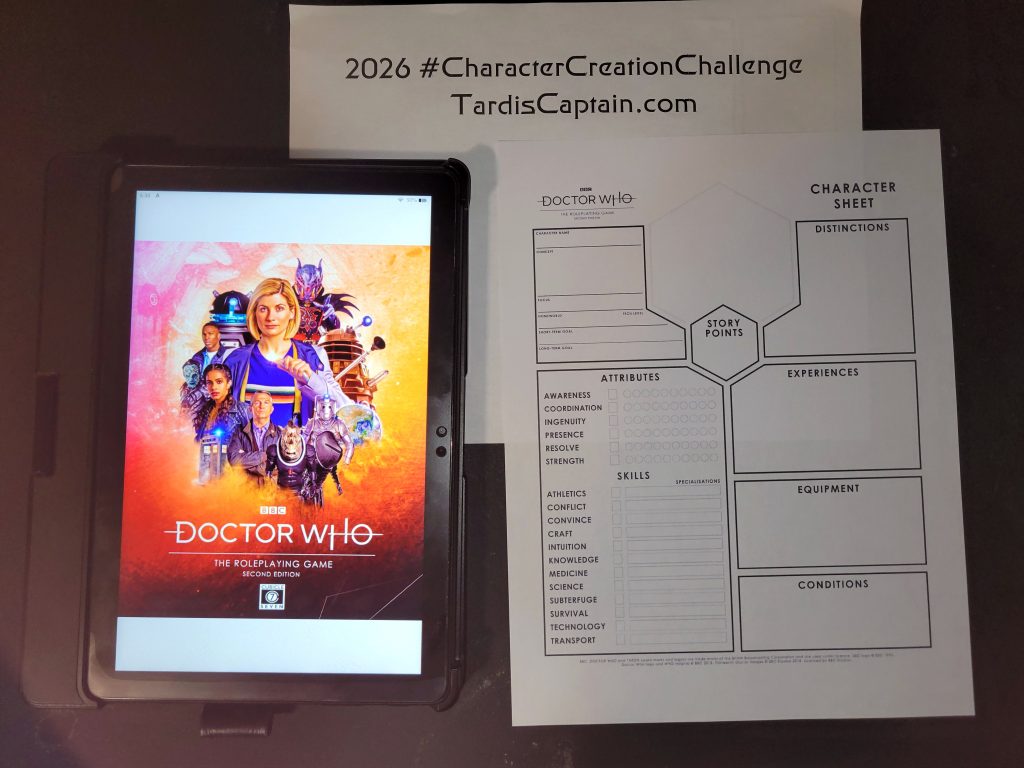
Here we are on Day 30 of the 2026 #CharacterCreationChallenge and today I’ll be using the Doctor Who Roleplaying Game 2nd Edition by Cubicle 7. I had created a character using the 1st edition of this game all the way back in the first challenge in 2021. Cubicle 7 also had a game called Doctors and Daleks (based off of 5e) that I used in the 2025 challenge. In 2021 I had also created a character for the FASA Doctor Who RPG (which I had ran back in the 90’s). Then earlier this year I created a character for the little-known Time Lord RPG. This creation journey allowed me to create my own Time Lord called The Barron, two human companions, and a Sontaran. So, my goal is to expand the team by making a robot/android type character. Why not a female character? I usually stick with male characters because I’m always worried that I’ll represent a female character wrong at the table. I just stick with what I know.
Chapter two talks about the characters you can play in this game. There are a lot of different steps that have explanations, but no summary that I can see. So, I’m going to try to follow the steps presented.
The first step appears to be The Concept. What type of character are you playing? As mentioned above, I would like to play some sort of Android. So, if he’s from Earth, it’s in the future. The more I’m thinking about it, yea, he’s an Android from the 2160’s. By that time, I hope we have a better grasp on android technology. This character was designed to be a teacher unit for the equivalent of college students. I jotted down some notes to add to the character sheet later.
The next item is The Focus. This is a single word that explains the characters’ drive or passion. This has both a positive and negative side to it, and the book recommends talking with the gamemaster about this. I talked with the voices in my head, and we agreed that the Explorer sounds good. This teaching android is taking an opportunity to expand his programming by experiencing some of the things he actually teaches. I hope that’s not too vague. If I had to defend it to a GM, I would say that he is more interested in learning the new experiences and may not be aware of what he is getting into. In the system if I was able to use the Focus, then I’d gain an extra d6 to a roll. To those familiar with the first edition, these two items are new to the game.
Experience appears to be the next section. This is what the character was doing before they started gallivanting around the galaxy with a Time Lord. It’s not a complete history, but I’m instructed to pick two major events that happened in the character’s life. There were a few examples listed, but they seemed pretty human centric. I’m going to use “Death of a Student” and “Invalid Source of Information”. With the first, there was a natural disaster at the school, and the android was with the student in their last moments. The second was the android discovered a source of information that they were instructed to use was incorrect. Even with submissions to get the data corrected, it was not. This last part made the character interested in “finding out for himself” so that he could present correct information in his class. In this same section is a Shared Background Experience or something that all the players got to go through together. It had some interesting options, but I have no TARDIS Team to hash this out. So, I’m going to skip this one for now.
Ah, now we are at the Attributes. If you read my blog entry for the first edition of the Doctor Who Rolplaying Game, the attributes are the same. Awareness, Coordination, Ingenuity (smarts), Presence (charisma), Resolve (willpower and determination) and Strength. These scores range from 1-6 with the average Human having 3’s in most of the categories. There are 18 points to distribute between the six attributes. I wrote them down on my notes what I thought an android would have.
Alright, so next is the Skills of the character. The Attributes are the physical and mental abilities and skills are things that everyone knows. They are Athletics, Conflict (aka fighting), Convince, Craft, Intuition, Knowledge, Medicine, Science, Subterfuge, Survival, Technology and Transport. There are 18 skill points that I can award to different skills. A score of 1 represents basic knowledge of the skill. The highest level is 6 which is renown expert. Any skill that has a score of 3 or higher then I can spend a skill point on a specialization. I wrote down the skills that I thought an android teacher would have and picked a specialization for a few of them.
Next is the character’s Distinctions. In the first edition this was covered by Traits. Well for this character he is an Android (I wrote down the details from one of the sample characters in the Doctor Who RPG 2nd Edition Starter Set) and Experienced.
Story Points are something that a player can use to tweak the narrative of the story in your favor. Most characters start with 12 points but you reduce this number by 2 for every distinction present. So this android character would have 8 points.
And now we wrap things up with the Finishing Touches. What is the character’s name? Advanced Learning Android Number 1701-Delta (aka Alan), a Background (the teacher story listed above) but there are ten questions listed in the book that would help players come up with this information (thank you). What is the Home Time Period and Technology Level (examples are provided), Personality (what? he’s an android), Personal Goals (learn more from experience) and Equipment (I really don’t know on this one). And since the book has started talking about Experience, I’m assuming the character creation process is done. Here is the one-page sheet.

Afterthoughts:
I ran the starter set adventure for this at a past SaltCON. From what I recall, going in cold it ran very well. I don’t think that the players knew that I was just as new to the game as they were. As I said then, I could very easily see myself running or playing this game.
This game really could have used a Character Creation Summary that fit on one page. If I was going to run this at the table, I’d probably write one up for my players.
There is a character conversion guide from the first edition to the second edition at the back of the book. I was glad to see this as I like seeing what the differences are between editions. I think it would also assist me with any homebrewing. But there is a large number of fan made publications where they hombrewed stats from the Doctor’s appearance in novels, comics and video games. Gah, I shouldn’t have pulled them up while working on this blog post. I got distracted by the shiny things.
Additional Notes:
While I was finishing up this character, I still had people reach out to me having just learned about this challenge. For those of you reading about the #CharacterCreationChallenge, welcome. I hope that the characters you see here, on other blogs, on social media or on the different RPG message boards inspire you to check out new games or even plan to participate next year.
Coming Up Next:
Star Trek
This article is open for discussion on the TardisCaptain dot Com Discord server. You can also email me at Carl (at) TardisCaptain.com or click on my social media links with any comments.