
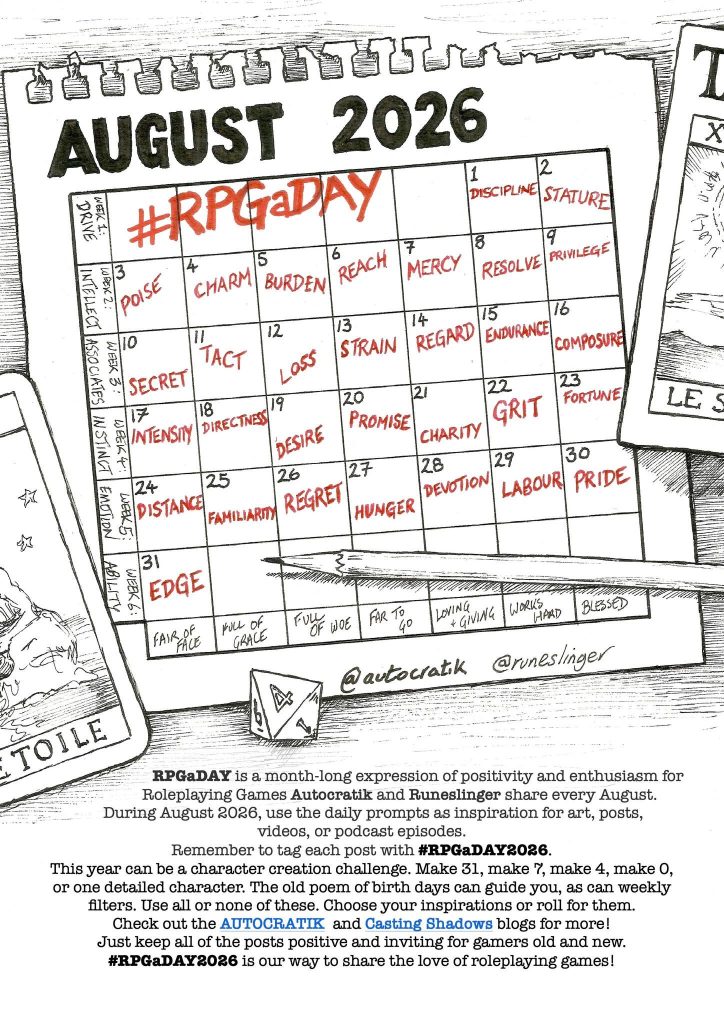
Day 7 Prompt: Mercy
Week 2 Prompt: Intellect
Weekday Prompt: Loving & Giving
I’ve had some very positive feedback on my Day 5 entry of Burden or Burned and my Day 6 entry of Reach. One fellow RPG bloggers commented that these were some of my best entries so far. Then they recommended that I use the same format for a fantasy setting. Well for day 7 of the RPGaDAY 2026 Challenge the prompt is Mercy.
Should I use Mercy or should I twist it? Tick, tick, tick…… processing complete. The following system agnostic entry can be used for Dungeons and Dragons, Basic Fantasy, Castles and Crusades, Fantasy Age or any of the many other fantasy RPG systems out there.
Journal of Prengar Derreth, 14th day of the royal year 1267.
I did it. I can’t believe that I’m on my way to joining the Order of the Macers. I’ve completed my first day of orientation here at St. Carthan’s Fort. I really wish I could tell you where I was, but new initiates are hooded for the last three days of the journey. When they pulled the hood off of me and the other candidates in the courtyard it felt like a breath of fresh air. Sure, we could take the hoods off as we slept in the enclosed tent at night, but not seeing sun or stars for three days was disorienting. Seeing the ramparts and towers covered by the banners of the different house mantles was a sight for sore eyes.
There are five house mantles that make up the order. The Heads, which consist of leaders and future leaders. The Hafts, which consists of the coordinators and logisticians. The Flanges, those who are instructed to strike swiftly or silently when called upon. The scholars and researchers are known as The Crowns and finally The Pommels who are the doers who get things done. All parts of St. Carthan’s Mace that are equal in providing mercy and justice. A single mantle cannot do the job alone; thus, we are all brothers. This was one of the first lessons we learned on day one orientation. To be a member of the Order of Macers is to be trusted or feared in the many kingdoms that we bring justice to.
Soon I’ll go through my first set of trials. How I pass them and work alongside my fellow initiates will determine which mantel I will join. I’m not certain which one I really hope to be admitted to. I have many talents that I feel can contribute to the order. I guess this is why the trials are here, to make that determination.
I was not surprised to see the many races of the land represented in the order. Humans, Elves, Dwarves, Halflings, Orcs, Giantkin, Centaurs, Dragonborn, Touched and Goblinoid. All had passed the trials and deserved my respect. None looked at me with eyes other than, will I uphold the order.
Then over the next two years, I’ll go through several more different trials. Each harder than the last. While different proctors and teachers will guide me during the first year, I’m really looking forward to the time when I’m selected by a Warden of the Order to be their Aspirant. Assisting the Warden will be one of my many duties in the Order’s mission to provide non-partisan justice and guidance across the lands.
I remember telling my mother that this would be a difficult life. I may never see the wheatfields of home again. But if I’m able to protect those fields and the members of my line that work them, then it will be all worth it.
The nightcall is about to go out. This is a time of rest which I will gladly take. Tomorrow, I know that my orientation will continue. Will I be able to keep up with my fellow initiates in the trials? I pray that my body is strong and my mind stay sharp.
-Prengar Derreth, Order of the Macers Initiate (by the gods it felt good to write that)
If you guys are getting Jedi vibes, that was rolling around in my head as the muses spoke to me. An order of knights that carried special maces (like the Jedi carried lightsabers) that distinguished them from other fighting forces. Known for balanced judgement and mercy when called upon by the general population. Some kings have blessed them, while others have cursed them.
I hope the thoughts that got loose out of my head have helped inspire you. What suggestions would you like to see for a future blog entry? This article is open for discussion on the TardisCaptain dot Com Discord server. You can also email me at Carl (at) TardisCaptain.com or click on my social media links with any comments.