As you can tell from the title of this Blog of Holding, I am a big Doctor Who fan. I remember playing the Doctor Who Role Playing Game by FASA with my friends in the 90’s. I remember even running a game. However it has been a LONG time since I even looked at the rules that I hardly remember anything at all. So this entry into the Character Creation Challenge is almost like reading it again for the first time. Unfortunately there hasn’t been any opportunity to participate in an RPG session lately. One friend still uses the name of her Gallifreyan character as a nickname. Hi Agiani.
When this game was published, the Gallifreyans did not allow for interference in other worlds. This made The Doctor a bit of a renegade with the leaders of his people. To get around this in the game, characters could be Gallifreyans or companions participating in a group called the Celestial Intervention Agency (CIA). The agents in this rogue organization battle against the threats of Daleks, Cybermen and dozens other aggressive species across space and time.
Since I’ve never made a Time Lord character, the character that goes by the name The Barron. His birth name is Redbronovurudu, but that was too hard to pronounce by his Human companion. “Red what? Like Red Baron?” “Oh.. The Baron, I like that. It sounds very noble.”
There are six mental and physical attributes in the Doctor Who Role Playing Game. Strength (STR), Endurance (END), Dexterity (DEX), Charisma (CHA), Mentality (MNT) and Intuition (ITN). Attribute scores range from 1-30 (with 30 being the best) but they are also listed at Attribute Performance Levels. Level I is Handicapped. Level II is Untrained. Level III is Basic Performance. Level IV is Average Performance. Level V is Professional Performance. Level VI is Expert Performance and the last performance of Mastery is Level VII. Characters will also have Special Abilities and Skills. The skills, like Attributes, range 1-30 and have their own I-VII proficiency ratings from Unskilled to Mastery.
Your character’s initial attribute scores start at 6. To find out how many points are in your attribute point fund, roll 2d6+36. I ended up with 43 points to spend. The Baron was a Researcher in the Grand Library of Gallifrey before he unexpectedly found himself traveling the universe. So I gave him higher scores in the CHA, MNT and INT scores. They are as follows: ST: 10 (Level IV), END: 13 (Level IV), DEX: 10 (Level IV), CHA: 15 (Level V), MNT: 15 (Level V), INT: 16 (Level V). During the character creation process, a 3d6 die roll determines if your character has a special ability, and what it is if present. My roll ended up earning a Luck special ability. This added 5 to my INT making it 12 (Level VI). Endurance rates for health was quickly discovered and written down.
Like the FASA Star Trek Role Playing Game, there is a large number of skills used in the game. This skill system in the character creation process was… ugh. After reading through the books several times I finally just selected some skills I thought a brainy guy would have (with some skills he would have needed in the field without getting greedy) and not worry about points. This is probably a section that I would have needed an experienced GM to explain things to me. I then decided to wrap it up and scan the character sheet.
Afterthoughts:
The character creation process is explained in the middle of the Player’s Manual after they have explained the items that go into a character and a short story with play examples. The rules talks about selecting a race, but there are no stat adjustments for the two races playable in the game (Human or Gallifreyean).
The books kept switching between the use of INT and ITN. This must have slipped through the editing process.
The Game Operations Manual had a section on Judging Character Creation. I had to refer to it in order to get some of the numbers needed in the character creation process. The section for determining skills was needlessly complicated and it took several read through to understand it all (I think). I understood that skill points from one attribute would purchase more skills that fell under that attribute (Higher STR score made it easier to buy STR based skills), but the way it was processed was just overly complex. There could have been a better way to figure these out.
If I recall correctly, we used pre-generated characters when we played this game. After going through this process, I can see why. I think this is the first day I got frustrated and ended the process.
Additional Notes:
I’m still looking for more blogs or message boards of people participating in the Character Creation Process.
Star Trek: The Role Playing Game (note the space between role and playing in the name) by FASA was one of the first non-D&D games that I had the opportunity to play. I was introduced to the game at the tail end of it’s run by some friends in high school and I remember eagerly awaiting the latest release of the new books and supplements. Besides my Father’s introduction to Star Trek, the FASA game was one of the biggest influences in my Star Trek fandom. References from the FASA game continue to show up including season two of Star Trek: Discovery and the IDW Star Trek comics in 2020.
The FASA Star Trek Role Playing Game is based on a percentile (D100) system. I liked this type of statistics for a game based off of a franchise because another thing fans like to do is compare characters on the show (or even with other shows). While a lot of D&D characters could have a Strength of 16, it didn’t help much with the comparison side of the coin. Now if character A had a Strength of 55 and another had a Strength of 60, that would be close, but distinguished.
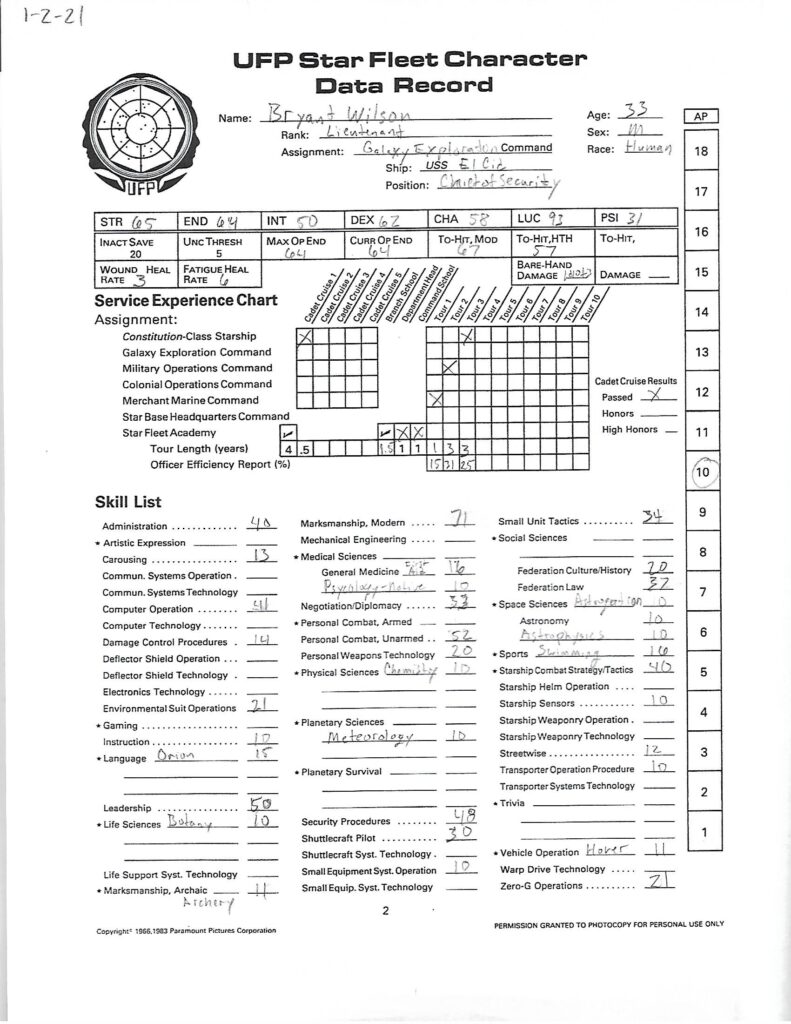
I decided to make a Human security officer named Lt. Bryant Wilson who will be serving in Starfleet during the time portrayed in the Original Series. While FASA had supplements that moved the game into the Star Trek Movies and the early days of The Next Generation, the primary focus was the Original Series with Kirk and Spock.
For the first five attributes of Strength, Endurance, Intelligence, Dexterity and Charisma, the player rolls 3d10 and adds 40 to the roll. The last two attributes, Luck and Psionic Potential, it was a straight percentile roll (D100). For Lt. Wilson I rolled the following stats. STR: 60 (rolled a 10+6+4). END: 60 (10+9+1), INT: 48 (3+3+2), DEX: 62 (10+7+5), CHA: 58 (10+5+3), LUC: 93 (whoa 93 on a percentile roll), PSI: 61 (again a percentile roll). The only racial modifiers for Humans is -30 to PSI which lowered this score to 31. In the RAW you roll another D100 and divide by two (rounding down). This roll was 23, which resulted in 11 bonus points. PSI cannot be increased and I am now allowed to put more than 30 in one attribute (no issue there). Most of my rolls were pretty good so I elected to put 5 points into STR and 4 points into END to help with his stats as a security officer (which brought both attributes up to 65 and 64) and the remaining 2 points going into INT (raising it to 50).
The next step was to pick my pre-academy skills. The number of points allowed was Lt. Wilson’s INT score divided by 10 and rounding down. So a total of 5. There were two categories to select from, Educational and Personal Development. I elected to put 3 points in General Medicine-First Aid (I figured he had to help in some capacity while growing up which may have led to his decision to join security) for Educational. From Personal Development I put 2 points into Streetwise. He had grown up living in a large North American city on the east coast. I randomly selected Baltimore.
At Starfleet Academy there were several skills that were learned as part of the curriculum in order to make a well rounded officer. I won’t list them all since they are in the rules, but I’ve added them to the character sheet. There were a few that I had to select the sub-skills. I selected Language-Orion, Life Sciences-Botany, Physical Sciences-Chemistry, Planetary Sciences-Meteorology, Space Sciences-Astrogation and Space Sciences-Astrophysics. I can select five outside electives at a rating of 10 each. Of these I selected Marksmanship-Archaic Weapon (Archery), Shuttlecraft Pilot, Negotiation/Diplomacy, Sports-Swimming and I added to my Streetwise (now up to 12). In my Advanced Study I get to add stats to the skills I already know. The number of stats I can improve is my INT score (50) divided by 10 (5) and add 5 which means I can roll a 1d10 and add that score to the skills I already know. I elected to add to Marksmanship Modern (rolled a 9, bumping this up to 29), Archery (+1 to 11), Negotiation/Diplomacy (+6 to 16), Computer Operation (+6 to 26), First Aid (+3 to 16), Zero-G Operations (+9 to 19), Federation Law (+7 to 22), Personal Weapons Technology (+10 (nice) to 15), Environmental Suit Operation (+1 to 11) and Personal Combat Unarmed (+4 to 24). I was done with the Academy Skills section.
Now onto the Branch School Skills. Luckily for the Security Branch School curriculum, it was pretty straight forward. Some new skills were added (such as Small Unit Tactics) and several had significant increases (+20 to Marksmanship, Modern) I added these skill points to my character sheet. There were two Outside Electives (any skill gets a 1d10) which I put into Carousing (rolled a 5) and Vehicle Operation-Hovercraft (rolled another 5). There was another round of Advanced Training. I could add a 1d10 to five skills I already knew. The Hovercraft skill got 6 (new total 11), Marksmanship Modern got 9 (new total 58), Small Unit Tactics got a 2 (new total 22), Damage Control Procedures got a 4 (new total 14) and Swimming got a 6 (new total 16). With that the Branch School was done.
Next was Bryant Wilson’s cadet cruise. It was a simple D100 roll with some modifiers for INT and LUC added (or subtracted). I rolled a 25 on the dice. My INT score didn’t alter anything, but since my luck was over 70, I took away 10 from the roll for a final of 15. This was exactly what was needed for a cadet cruise within the Exploration Command on a Constitution class starship. That high LUC really helped out. I marked that on my character sheet. The results of the cadet cruise was another D100 with additional modifiers. I rolled a 71, subtracted 20 for the cruise being on a Constitution Class and subtracted another 10 for the high LUC score for a grand total of 41. This resulted in Bryant Wilson passing his cadet cruise and earning the rank of Ensign. When I saw these results, I decided that Ensign Wilson had taken his cadet cruise on the USS Kongo.
After the cadet cruise, Ensign Wilson was sent to Department Head School which resulted in three things. Several new skills were added/gained (Administration, Computer Operation and Leadership), more Advanced Training. Five skills already known get a 1d10 advancement. These were Negotiation/Diplomacy got a 7 (new total 23), Small Unit Tactics got a 9 (new total 31), Marksmanship-Modern got a 4 (new total 62), Carousing got a 4 (new total 9) and Personal Combat Unarmed got a 5 (new total 49). The last thing earned was a rank advancement to Lieutenant (j.g.).
Next the RAW has Lt. (j.g.) Bryant Wilson going to Command Schools (there are a lot of schools in this game). I can select five skills and take the points listed. Well Starship Combat Strategy Tactics is a huge gain (40 points), Negotiation/Diplomacy is nice (another 10 for a total of 33), 10 more to Leadership (new total 40), Federation Law gets 10 (new total 37) and Federation Culture/History gets 5 (new total 20). Lt. (j.g.) Wilson has now been promoted to Lieutenant.
Now we get to determine the number of tours served. The eventual end goal is to make the character the Chief of Security on a starship. I was instructed to roll a 1d10 and divide by 2 (rounding down). The roll was a 7 resulting in three tours. My high LUC once again came in handing reducing the number of tours by 1. I needed to reach the rank of Lieutenant, so I didn’t need to add a tour for that requirement. However I need to add a tour for becoming a Department Head. The final total of tours needed would be three. If the game was going to be be held on a Constitution-class starship, there would have been one additional tour added. All the tours are determined by a D100 roll with modifiers.
The first tour rolled a 73, high LUC reduced this by 10 to 63. Wilson would be serving in the Merchant Marine Command (I decided he was serving onboard a Starfleet operated freighter known as the USS Whitlock). He must have done a good job because he ha a total Officer Efficiency Report of 15 (25 roll -10 for high LUC) which gave a rating of Excellent. The tour lasted 1 year (1d10 roll resulted in a 2, divided by 2 to get the one year) For serving in the Merchant Marines, I was able to add a 1d10 to either Carousing or Streetwise. I rolled a 4 that was added to Carousing (new total 13).
For the second tour I rolled another D100 and consulted the Tour Assignment Table. My Excellent rating gave me a -10 and my high LUC gave me another -10, so I rolled on the table for -10 to -20 (this way was set up that poor performances would not be rewarded with plumb assignments such as the coveted Constitution-class starships). I rolled a 42 (hey the answer to life, the universe and everything) which resulted in a tour within the Military Operations Command. I decided that Wilson was transferred to the USS Joan of Arc, a Larson class-destroyer. The tour lasted 3 years (1d10 roll resulted in a 7, divided by 2 and rounded down). For an Officer Efficiency Rating I rolled 41, modified by the high LUC to 31 resulting in As Expected.
The third tour rolled an 06 (Wow!) which consulting the table resulted in an assignment to a Constitution-class starship. That’s a feather in the cap for Wilson as he got to serve on the USS Constitution for three years (length roll on a 1d10 was a 7). There he earned an Officer Efficiency Rating of Excellent (roll of 35 minus 10 for the high LUC resulting in an OER of 25). This excellent rating is what probably got him noticed for his in-game assignment as the Chief of Security on the USS El Cid, an Anton-class cruiser.
Now these tours resulted in several skill increases. We already mentioned the Carousing from the Merchant Marine tour listed above. There was a total of seven years in service so one additional 1d10 can be added to skills already known for each two years (3 rolls total). Since at least two years was spent on a Constitution-Class, that adds another roll. High LUC scores again adding two additional rolls. So for the six rolls in total I added the following. Leadership gets a 10 (for a new total of 50). Small Unit Tactics gets a 3 (new total 34). Personal Combat Unarmed gets a 3 (new total 52), Security Procedures gets an 8 (new total 48). Zero-G Operations gets a 2 (new total 21) and Marksmanship-Modern gets a 9 (new total 71).
Lt. Wilson’s age is 33. He was 18 when we started the academy which took 4 years to complete. Half a year for the cadet cruise. 1.5 years for the branch school. A year each for department head school and command school and the three tours took 7 years.
Max Operating Endurance and Current Operating Endurance equals the END score. The Wound Heal Rate for Wilson is a 3 (END divided by 20, rounded down) and the Fatigue Heal Rate is 6 (END divided by 10, rounded down). Action Points came up as a 10 (DEX divided by 10, rounded down then add 4). The To-Hit Mod score is the average of the DEX score with the skill of Modern Marksmanship (62 added to 71 divided by 2 and rounded up = 67). To-Hit HTH (Hand to Hand) score is the average of the DEX (62) score with the skill of Personal Combat-Unarmed (52) which resulted in 57. Bare-hand damage is 1d10+3 due to his STR score of 65. Here is the final character:
Afterthoughts:
While discussing character creation for Star Trek Adventures, a friend stated that he preferred it over FASAs +5 to a skill here and +5 to a skill there. The FASA system was a little bit longer, but I felt that I could see the character forming before my eyes. Character creation would definitely have to be a session zero meeting between players and game master. If I was the GM for new players I’d also give them a little bit of leeway to go back and change some skills. In hindsight I should have given Lt. Wilson a skill in armed combat with sword or some unique weapon. I also like the Trivia catch all skill (even thought I didn’t use it on Wilson).
I also don’t know if I’m going to go into so much creation details on future entries. I need to pace myself if I’m going to make it through the 31 day challenge. I just get inspired to start typing and next thing I know I’m just continuing to type.
Additional Notes:
I’ve decided to start adding links to other blogs and message boards where players are participating in the Character Creation Challenge. I’ve had people ask if they can still participate if they didn’t start on January 1st. The answer yes, just pick up from today and move forward. If I don’t have your location linked, send me the URL. For social media (twitter, facebook, etc.) just use the hashtag of #CharacterCreationChallenge. I can’t link all social media sites, but I know they are coming up under that hashtag.
Also thank you to those who gave feedback to my Character Creation Challenge entry for Day 1. I had to go back and make a few minor corrections. I had been a while since I had created a character in the BECMI system.
Part of the reason I put this website together was to give a home to some of the creative works I’ve put together. While I don’t have a novel to release (yet), I have created some items including some home-brew stats for various role-playing games.
For the Star Trek Starship Tactical Combat Simulator by FASA, they created a Starship Construction Manual. This book contained charts and rules to create Federation, Klingon, Romulan, Gorn and Orion starships. I used this book in the 90’s for quite a few creations. Usually my targets were the various starships seen in different fan made technical-manuals and blueprints. The ships had already been designed and contained enough statistics to convert into game statistics. I would then type of the stats, photocopy the image of the ship and quite literally cut-and-paste. I was able to make one look really fancy (Belknap), but most were just the text and an image of the ship.
I had made a master book of starships for the game. I had copied all of the ships from the various manuals, modules, magazine articles and fanzines and placed them into a three-ring binder alongside my own creations. As you can imagine, this book became quite thick. Luckily I was able to keep this book through all of my moves and I recently pulled it out of a storage box. I selected three creations at random and scanned them into the PDF format. If I had enough background details, I would include it with the statistics. Since this was the time before Google, I didn’t know the reason behind some of the class names.
I didn’t have any construction stats for the Tholian and Kzinti races, but that didn’t stop me from at least attempting to create game statistics for them. I never had the chance to play test them, but I’ll be presenting them on this site. So for the first three samples I have selected the Belknap Class Strike Cruiser, The Klingon D-15 K’Teremny Class Cruiser and the Kzinti TC-1 Police Cruiser. I may re-write some of these with the computer tools available now, but until then I’ll be presenting them in the format I originally saved them in. Enjoy.