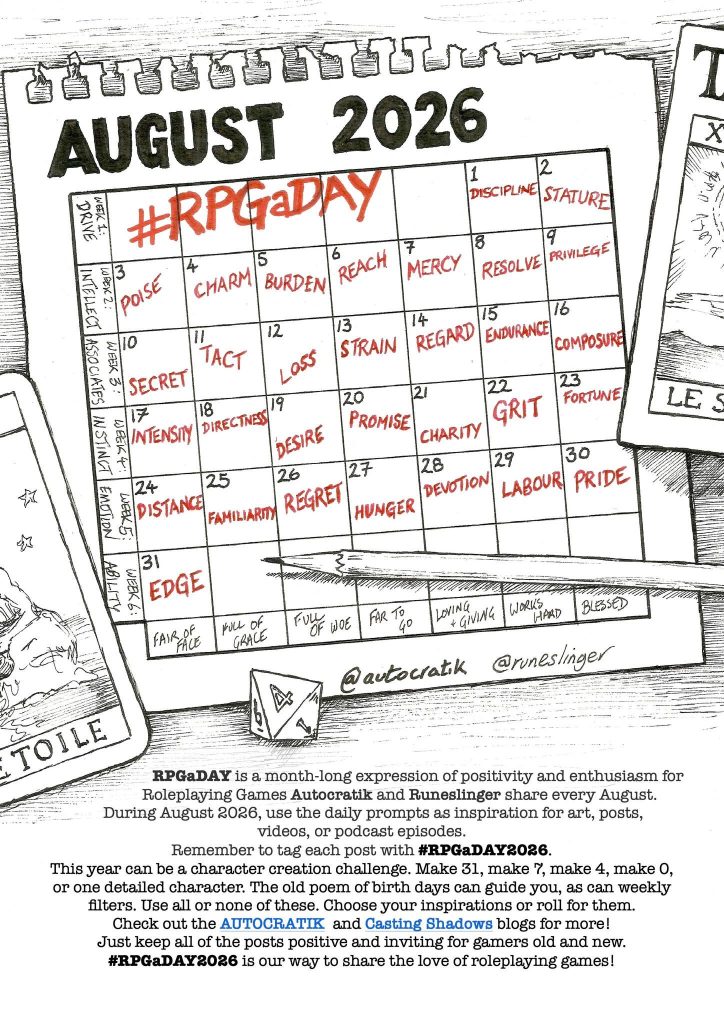
For Day 16 of the RPGaDAY 2026 Challenge and I’m going to be twisting the prompt of Composure from something vague to something directional. And this could fall in most RPG genres that I’ve already used several times this month. Gee, it’s almost like I’m interested in playing in these particular genres. So, for your sci-fi, pulp or fantasy game please consider the use of The Five Bearings of the Compass Guild.
North Bearing
Virtue: Endurance Color: Deep Blue Motto: “Hold Fast.“
North members are explorers, scouts, and guides who refuse to quit.
When others turn back, the North continues.
Associated with: Survival, Perseverance, Long expeditions and Frontier exploration
These are the cartographers, scholars, translators, and researchers.
The first to study a map. The last to stop asking questions.
Associated with: Intellect, Discovery, Learning and Investigation
South Bearing
Virtue: Service Color: Green Motto: “Leave Others Better.“
The most community-minded Bearing.
Members often become: Healers, Diplomats, Relief workers & Pilgrim guides
Associated with: Giving, Compassion, Charity and Stewardship
West Bearing
Virtue: Adventure Color: Crimson Motto: “Beyond the Horizon.“
The daring members.
Explorers. Pathfinders. Treasure hunters.
Often blamed for incidents.
Associated with: Courage, Curiosity, Risk-taking and New frontiers
Center Bearing
Virtue: Composure Color: White or Silver Motto: “Remain True.“
The rarest Bearing.
Center members train as: Mediators, Leaders, Masters and Judges
Like the pivot point of a compass, they remain steady while others move around them.
Associated with: Balance, Wisdom, Leadership and Calmness
Founder’s saying that is recited upon initiation or at the start of meetings:
“North endures. East learns. South serves. West ventures. The Center remains true.“
Which Bearing house would your character be in? Tell me about it. This article is open for discussion on the TardisCaptain dot Com Discord server. You can also email me at Carl (at) TardisCaptain.com or click on my social media links with any comments.
Probably one of the better RPG recommended prompts for the RPGaDAY 2026 Challenge and we are provided with “Endurance”. I wonder if this was chosen for Day 15 since it’s the midpoint of the month. I’ve known some participants who have already dropped out already (dang real life). I’ve also been tempted a few times myself, but I think forcing my way through some of these prompts has been a mental challenge.
So where am I going to take this prompt? I’m going to stick with the (now evolved) theme of providing seed ideas with different locations and vessels. I hope you enjoy it.
INCOMING TRANSMISSION
TO: Personal Terminal-Ms. Matilda Harper, Perth, Australia, Terran Confederation
FROM: Personal Terminal-Spacer First Class Ward Harper, Starship Endurance, Fleet Command
CLASSIFICATION: Personal Correspondence- OPSEC cleared
Mum,
I hope that you are doing well. I was pleased to hear that Doc Callaghan had cleared you from your last round of treatments. Please continue to follow his instructions. He knows his stuff unlike those AI-Assisted Digital Companions that still can’t seem to get a diagnostic right. I think that I’m starting to understand dad’s analog way of doing things, especially now that I’m settled down in my new assignment.
In my last letter I told you that my professor at Fleet Academy seemed to have a smirk on his face as we all gathered for our new assignments after graduation. I told you that he seemed to have it out for me. I couldn’t write to you before now because of how busy we’ve been. Packing up our gear. Many different transport stops. Clearing customs and keeping out of scraps along the way. But I’m finally berthed at my assignment.
I’m on that ship, the one everyone keeps talking about. The Endurance. The oldest operational vessel in Fleet Command. I remember when we disembarked from the transport shuttle and one of the other green members asked the Senior Bosun if we were here to help decommission the ship. This old guy just smirked and said “Son, you’ll either be dead, retired or the Grand Admiral of the Fleet before the Endurance is actually decommissioned.”
After getting my bunk, the first thing they had us all do was a temporary assignment with the Cargo Master. I tell you, this woman has the mind of a steel trap. She knew exactly where everything needed to go, what label needed to be on what container and how to rotate the containers so that the oldest items could be accessed first. The entire time I was around her, I don’t think she looked at her digital display device more than twice. I recall her telling the Senior Bosun that she’d rather have another round of arguments with the Syndicate Pirates than the Customs Officials of Oreth Prime.
After we got the resupply stocked and secured, I was finally released to my permanent assignment. I reported to Maintenance Chief, Lt. [redacted]. I walked more steps here than all my years at the academy. The Endurance must be twice as large as a similar cruiser class vessel. This makes for more corridors and access shafts. Lt. [redacted] stopped at one junction and just tilted his head. Then he had me note down that Circuit [redacted] needed to be replaced on the next maintenance cycle. When I asked him how he knew that he just shrugged and said, “The Endurance just talks with you, if you know how to listen.” I think he was serious.
After my first round with the Chief, we were told to report to the Arboretum, where we had our first meeting with Captain Henline and Exec Rosales. We got our official welcome aboard and an introduction to the senior staff. I could tell that Captain Henline has confidence in his team by the way he talked about them. The one that didn’t talk much was Executive Officer Rosales. When it came time for him to talk about his role, he only said that he represents the crew to the CO but is the first to follow the COs orders. I overheard one of the Ensigns whispering that Rosales scared him more than the visiting Admirals they had the week before.
One of the members of the senior staff came up to me just after our meet-and-greet with the staff. It was Lt. Commander Victoria Shellby, the ship’s archivist. Apparently, the Endurance is so old that there is a permanent historian on board. She immediately asked me if I knew the late Jack Harper. When I told her that was my dad, she put on a big smile and asked me to follow her. As we kept getting deeper and deeper into the lower sections of the ship, I was starting to wonder what was going on. Was this part of some prank on the newbies joining the Endurance. But eventually, after passing through three generations of replacement sections, a weird sign that says, “DO NOT REMOVE, IT IS LOAD BEARING.” (she couldn’t tell me what “it” was) and past a coffee maker that was older than I was, she pointed at some graffiti on a hull plate. There, etched in with a plasma welder, was the name “Senior Technician Third Class Jack Harper”.
I didn’t know dad served on the Endurance? He never talked about his time in the fleet. No wonder he loved the analog way of doing things. First, I was upset about getting this assignment. Sure, I wasn’t at the top of my class. But I felt that I had put in the effort to earn a berth on a Madagascar Class Cruiser or a Jefferson Class Destroyer, not the oldest ship in the fleet. Now… now I’m happy to be here. Lt. Commander Shellby didn’t say anything as I bawled. I know dad has been gone for a couple of years now, but this connection confirmed my decision to follow his footsteps into the academy. I hope what I do here will make both you and him proud.
END OF TRANSMISSION
Again, Carl looks at the screen after typing this up. Did I do good? Do you think the environment of the oldest ship in the fleet would work for a campaign setting for Star Trek Adventures, Traveller, FrontierSpace or a host of other science-fiction RPGs out there?
This article is open for discussion on the TardisCaptain dot Com Discord server. You can also email me at Carl (at) TardisCaptain.com or click on my social media links with any comments.
Regard is the Day 14 prompt for the RPGaDAY 2026 Challenge…. and I’ve got nothing. I wracked my brain for this topic, and I really don’t know what the organizers are going for. Let’s look at some of the other entries that have been posted for inspiration. (Checks BlueSky social media)
Wait, Fellow RPG blogger Craig Oxbrow asked a question “What is a game held in high regard you have yet to play?” Perfect, I’m going to go with that one. Thank you Craig. (and after I started working on this, it looks like other participants used this same idea)
“Have yet to play?” Hmm… I’m going to break this into two categories since they would both count. “Never played” and “Never played outside of a one-shot.” As I’ve mentioned in my SaltCON reports, when I sign up for RPG sessions at conventions, I try to play at least one game I’ve never played before. I had also had the pleasure of being invited to a few one-shots outside of conventions (thanks guys). And no, I don’t count making characters for the Character Creation Challenge as playing the game.
Amazing Adventures– This is the “D20 Modern” variant of Castles and Crusades by Troll Lord Games. It’s a D20 based system that uses the siege system for resolving skill issues (driving a motorcycle, climbing wall, finding a hidden item, haggling with a merchant for a lower price, etc.) What I like the most about this system is it allows the player to say, “I want my character to do this” instead of “My character sheet says I can only do this.” Kind of like how you can with the 2D20 system Star Trek Adventures by Modiphius.
Planet of the Apes– The D6MV (the “magnetic variant” of the D6 system used for the Star Wars D6 game from West End Games). This game had a very successful KickStarter from Magnetic Press Play. Yes, I ran this at a SaltCON, but it was the intro adventure from the Quickstart. I would really love to play this in a campaign as a player.
Traveller– The latest version from Mongoose Publishing. 1- I’m a fan of science fiction. 2- This is one of the original RPGs that shaped a generation like Dungeons and Dragons did. I’ve seen the 2d6 system spawn off many retro-clones and imaginations. So I’d like to try it in a campaign at least once.
FrontierSpace by DWD Studios. This company is a small one-man operation that has put out a lot of different games . This entry covers science fiction and is his love letter to Star Frontiers (while using an original system). He has also created the espionage game, White Lies, which should also be on this list. While White Lies is based off of the Whitebox Fantasy Adventure retro-clone, the system used for FrontierSpace is very unique. It also has the “do what I want, not what my character sheet says” vibe.
And you know what? I’m going to call it there before this turns into a post 20 miles long. There are quite a few more that I could hold up and state that I hold it in high regard. I own them either in PDF or deadtree version. I’ll probably bring them up in future blog posts.
What are the four games you’d hold up in high regard that you haven’t played yet? Tell me about it. This article is open for discussion on the TardisCaptain dot Com Discord server. You can also email me at Carl (at) TardisCaptain.com or click on my social media links with any comments.
Day 13 of the RPGaDAY 2026 Challenge and I’m going to go with a storyline that I’ve had rolling around in my head for quite some time. I never knew if I wanted to make this an RPG session, Star Trek fan fiction or an original science-fiction story.
Communications Station Four-Seven-Bravo-Bravo-Echo
SIGNAL QUALITY: 17% degradation detected- aided restoration attempted
–Video Starts–
(static fades, interior of a Washburn Class starship command center is seen. Some panels are in different states of disrepair. A human male with a dirty uniform is seen sitting at the command station.)
(off screen female voice) “I think it’s going through now sir, but I don’t know how long we’ll have access to the subspace channel.”
“Fleet Command, I hope you are hearing this. (static) This is Captain Gabriel Costa of the Starship Venture. I don’t know if this message will reach you in time. If you haven’t been hit by the (inaudible static) wave, then you may only have weeks, days or even hours depending on how long this (garbled audio) message makes it through comms.”
Sparks fly off of one of the panels behind him.
(warped voice distortion) “Three years ago…” (voice normalizes) “…the Venture encountered an unknown anomaly that flung it over 4,700 sectors away from Its previous position. (static) “…our true location, we started the journey back home. During that time…” (garbled) “…a danger that affects all inhabited planets in the home sectors.”
(screen becomes full static before returning 35 seconds later)
“…at which time we discovered that the group was fleeing from something called the Delta Wave. This…” (voice distorts) “…wave will cause FTL drives to malfunction and eradicate certain organic compound…” (voice normalizes) “…unless it was shielded by…” (static) “… which protects some vessels and ground-based compounds but devastated entire civilizations that were caught unprotected. Many vessels of unknown origin are in a constant state to outrun the wave.”
Captain Costa wipes his brow with a dirty hand.
“As per fleet regulations, we attempted to assist where we could but quickly found ourselves at the magnitude of this disaster. Unknown forces attempted to commandeer the Venture. We suff…” (voice distorts) “…ered many casualties and attempted to flee away from the wave. So…” (voice distorts even more) “…far the science department has calculated the wave to be large enough to cover several sectors. We sti…” (voice normalizes) “…ll haven’t discovered the edge of the wave. Professor Viggan believes that the wave is growing with each system it engulfs. Other than the elements it consumes, the planets and stars are still present, but unreachable by the other side of the Delta Wave.”
(The video continues with an agitated Costa speaking, but there is no sound for 20 seconds)
“…is our last confirmed coordinates. I made the command decision to break radio silence in attempt to warn the fleet of this impending disaster. We have detected several vessels converging on our location. We will attempt to evade them and contact…”
(signal ends)
FROM: Automated System for Communications Station Four-Seven-Bravo-Bravo-Echo
TO: Regalas Sector Command, Fleet Command Base 94
PRIORITY: High
Message Start. Long range sensors have detected a large number of vessels approaching from the Tenkor Rift heading towards this sector. Identification scans: inconclusive. Total number: inconclusive. Propulsion sources: varied, but inconclusive. ETA: 108 Terran Hours. Sensor scans and unconfirmed message from Starship Venture (Registry 800437) attached in datapacket. Message Ends.
Did the seed get planted? Do you think that the Venture was able to survive the strain of being trapped in a remote sector surrounded by desperate alien vessels? Tell me about it. This article is open for discussion on the TardisCaptain dot Com Discord server. You can also email me at Carl (at) TardisCaptain.com or click on my social media links with any comments.
Because I liked the more humorous post of T.A.C.T. that I presented on Day 11, I’m going to keep going with the humorous entries. For Day 12 of the RPGaDAY 2026 Challenge the prompt is Loss. Well, loss and lost are close enough in my book and I was able to get some creative juices flowing with the later. (evil grin)
Basio Quill’s daily routine observed on 14th Day of the King Year 5279:
6:00 Unlocks door to Lost Property Office in the Secondary Southwest Government Annex for the City of Xarta. While the door is only hanging by one hinge, as per regulations, the door must be unlocked during business hours.
6:05 Checks for any incoming messages. Sends another message to the maintenance department that the door has not been repaired in 1,706 years and forty-five days since the initial request was submitted.
6:10 Waters the office plant. Checks growth rate. Notes that plant has not grown since it died after the city fell into ruin and everyone fled.
6:20 Review Overnight Claims. One explorer lost his hat. A cursed dagger was lost by a cultist. Three adventurers report “something important” is missing.
6:45 Dust Reference Shelves. Since office is currently buried in a partially collapsed building, dust returns immediately.
7:30 Morning Tea (Oil). Tea is terrible. Tea has always been terrible since the supplier has become unreliable since the fall of the empire.
8:00 Process Forms 12-B through 447-V. No one has requested these forms for centuries, but still one must be prepared.
9:00 Files Complaints. Recent examples include: Traps insufficiently marked. Mummies hostile. Map misleadingly accurate. Snakes are larger than expected.
10:00 Answers Questions from Adventurers. Standard responses already prepared for common questions like ‘Why is the city cursed?’, ‘Where is the treasure?’, ‘Why is the floor shaking?’.
11:00 Lunch Break. Since Basio doesn’t eat, he just sits there for an hour in silence. It’s tradition.
12:00 Update Missing Person’s Register. Several entries updated from ‘Missing’ to ‘Regrettably Found’.
13:00 Catalog Artifacts. Categories Include: Valuable, Dangerous, Extremely Dangerous, Should Not Have Been Touched and Returned to Professor Wainwright.
14:00 Checks on City’s Lost Prophecies Shelf. The shelf is nearly full. Prophecies are far more common than their authors would have us believe.
16:00 Polishes Nameplate and Tidies Desk. Nameplate reads ‘Basilio Quill: Senior Assistant Deputy Registrar of Lost Property, Third Class’. He was hoping to make Second Class, but the city collapsed before his promotion interview.
17:00 Closes Office. Locks door. Places key in designated drawer. The designated drawer was lost during an earthquake. Basilio records this fact in the appropriate ledger.
When the city fell nearly 2,000 years ago, everyone fled, the city was buried, the kingdom collapsed, the government ceased to exist, and the gods abandoned the region. Basilio Quill remained because of Municipal Regulation 14-B “No keeper of records may abandon his post while property remains unclaimed. According to his ledger, seven unresolved claims were still present. While civilization was gone, the paper remained valid, so Basilo stayed at his post. Because of the spell of employment (or programming) Basil is now an undead skeleton/broken autonomation in spectacles and tattered attire as he dutifully staffs the Lost and Found Office.
If any adventurers find him, he will be disturbed if any questions are asked as the inappropriate time. If they state that they are there to find a lost item, he will ask them to take a number and eventually asking for proof of ownership or a claim ticket. Basilo’s responses should be laced with boredom from bureaucracy and the sarcasm needed to survive a mundane office job. He is completely polite, completely helpful and completely defeated by bureaucracy. He would react to any horrifying adventurer behavior the way a stuffy librarian reacts to someone disturbing the quiet of the library.
Common Answers:
“Welcome to the Lost Property Office. Please take a number.”
“We’re the only people here.”
“Then I recommend Number One.”
“How long have you been dead?”
“That information is available upon submission of Form 38-C.”
“Do you have Form 38-C?”
“No. It was lost.”
“You’re alive!”
“That matter remains legally ambiguous.”
“Who are you?”
“Basilio Quill, Senior Assistant Deputy Registrar of Lost Property, Third Class.”
“And what do you do?”
“Mostly wait.”
“We’ve come for the Ruby Eye of Karak-Zul.”
“Excellent. Do you have your claim ticket?”
“It’s a legendary artifact.”
“So is a hat, if enough time passes.”
“Someone stole our map.”
“Then your complaint would belong with the law enforcement division-theft.”
“Where is Theft?”
“Stolen.”
“You get a lot of explorers down here?”
“Unfortunately.”
“What usually happens to adventurers?”
“Would you prefer the statistical summary or the pie chart?”
“Has anyone ever escaped the city?”
“Many.”
“Successfully?”
“Ah.”
“This city is cursed.”
“Everything is cursed.”
“Everything?”
“The stapler is particularly dangerous.”
“You keep records of everything?”
“Everything.”
“Everything?”
“On page 847, an explorer reported losing confidence in 431 A.E.”
“Did he ever find it?”
“No.”
“We’re missing our guide.”
“Description?”
“Short. Nervous. Kept warning us to go home.”
“I have eighty-seven entries matching that description.”
“One of my associates disappeared.”
“Voluntarily or adventurously?”
“What’s the difference?”
“The paperwork.”
“How did the city die?”
“Budget cuts.”
“This prophecy says we are the chosen ones.”
“Congratulations.”
“You don’t seem impressed.”
“That is the fifteenth chosen party this month.”
“Why don’t you leave?”
“Retirement requires authorization.”
“From whom?”
“My supervisor.”
“Where is he?”
“Missing.”
“What’s the strangest thing anyone ever lost?”
Basilio adjusts his spectacles and consults a ledger.
“According to the records, an adventurer named Percival Smythe misplaced an entire civilization.”
“How does that happen?”
“The notes simply state, ‘It was here yesterday.'”
This system agnostic RPG post could work in a variety of genres. For something like Star Trek Adventures or Frontier Space, the party could find a run-down robot/android still following his programming. For pulp adventures like Everyday Heroes and Amazing Adventures or a fantasy setting like Castles and Crusades or Basic Fantasy, Basilio would be some form of minor undead/litch cursed to keep working after he has passed away. Probably by a spell put on all employees to keep them working during turbulent times. Perhaps breaking the spell will allow Basilio to find the peace that he has lost.
Did I make you smile? Perhaps even giggle? This article is open for discussion on the TardisCaptain dot Com Discord server. You can also email me at Carl (at) TardisCaptain.com or click on my social media links with any comments.
So, after yesterdays deep blog post for Secret, I decided to have a little fun with the day 11 entry to the RPGaDAY 2026 Challenge. The prompt is Tact, which I’m going to turn into an abbreviation for Transcontinental Association of Civilized Travelers.
Professor Archibald Wainwright III let a slight curl of a smile show as he placed his teacup back on the saucer. The candidate he had been tasked at observing had just entered The Oak Room at the expected time of three minutes before the hour. While the other eyes in the room seemed shocked, he was not.
“So right on time I see.” The professor stated as his companion took a seat across the table from him. “May I ask how you were able to gain access to the inner sanctum of this exclusive club?”
The professor noted the confidence in the candidate’s smile as he spoke. “I followed the clues and easily found the location. As for how I obtained entrance.” He raised an eyebrow. “Let’s just say no one was hurt in the process, and we’ll leave it at that.”
Professor Wainwright thought about pressing for a second but then dropped it. Keeping one’s cards close to their chest was an admiral trait in their secret society. He pulled a large, sealed envelope from his coat pocket and slid it across the table.
“What we discussed at Lady Rochelle’s party is contained within this envelope. I’m certain that you’ll read it in discretion. If you wish to pursue the matter, then fill out the documentation and re-seal the envelope. It can be left in the back seat pocket of any Hollings-Smith taxi, and it will be delivered to the right destination.” Professor Wainwright reached for his teacup again and smiled. “I’m sure that you can see to your own exfiltration from this location before some burly gentlemen locate you.” Taking a sip, he returned his attention to his copy of the Times.
Transcontinental Association of Civilized Travelers (T.A.C.T.) Membership Application
Please answer all questions truthfully so that a proper evaluation can be made by the guild membership board. All applications will be thoroughly checked for accuracy.
Basic Information:
Full Name:
Alias(es):
Secret Alias(es):
Date of Birth:
Place of Birth:
Astrological Sign:
Lucky Number:
Unlucky Number:
Catch Phrase:
Unique Weapon/Equipment/Transport of choice:
Unique Article of Clothing (note if bulletproof):
Base of Operations (note if secret):
Associates:
Known Adventuring Family Members:
Known Doppelgangers or Clones:
Known Psychic Pets:
Living Sidekicks:
Deceased Sidekicks:
Arch-Enemy (Include Guild of Calamitous Intent ID number):
General Qualifications:
Have you traveled to at least three continents?
Have you disembarked one of those continents in a hurry?
Have you ever been declared dead in error? (note number of times)
Have you discovered a lost city?
Was it already occupied?
Did the inhabitants object to your presence?
Have you ever removed an object of interest from a resting place?
Did the resting place immediately begin to collapse?
Were you surprised by this?
Transportation:
Check all forms of transportation from which you have escaped-
[ ] Airship
[ ] Biplane
[ ] Zeppelin
[ ] Steamship
[ ] Train
[ ] Runaway Train
[ ] Train hanging from a broken bridge
[ ] Giant Mechanical Spider
[ ] Alien Spacecraft
[ ] Other _________
Associate History:
Have any of your associates-
[ ] Betrayed you?
[ ] Been revealed as royalty?
[ ] Been replaced by an imposter?
[ ] Been controlled by an ancient artifact?
[ ] Turned out to be an intelligent monkey?
[ ] Became royalty after betraying you?
Scientific Matters:
Have you ignored the warnings of a scientist?
Have you ignored your own warnings?
Have you awakened something that should have remained asleep?
Did you do so in the interest of science?
Encounters:
Check all forms encountered during your adventures-
[ ] Dinosaurs
[ ] Mummies
[ ] Cultists
[ ] Mad Scientists
[ ] Not mad, just disappointed Scientists
[ ] Scientists currently in therapy
[ ] Cannibals
[ ] Amazons
[ ] Aliens
[ ] Cryptids
[ ] Honest Politicians
[ ] Giant Snakes
[ ] Giant Spiders
[ ] Giant Ants
[ ] Giant versions of something that shouldn’t be giant
Wealth Level:
Please indicate your financial status:
[ ] I had to borrow a pen to complete this application
[ ] I clip coupons, but I’m doing ok
[ ] I have a nest egg
[ ] I don’t have to ask how much when ordering anything
Club Conduct:
[ ] I solemnly swear to describe every obvious deathtrap as perfectly safe
[ ] I shall never spilt the party unless dramatically appropriate
[ ] I shall maintain a calm demeanor while pursued by hostile natives, criminal masterminds, or cursed statuary
[ ] I understand that “Do Not Enter” is generally a suggestion
Character References:
Please supply three references whom are Partially Living, Currently Living or Not actively seeking revenge.
Reference #1:
Reference #2:
Reference #3:
Final Question:
Have you ever looked at a plan and said, “What could possibly go wrong?”
[ ] Yes
[ ] No
[ ] I refuse to answer on advice of council
Declaration:
I certify that the above statements are true to the best of my knowledge and that any inaccuracies are likely the result of hypnosis, amnesia, time travel, or an encounter with an ancient civilization possessing advanced but poorly understood technology.
Applicant Signature:
Witness Signature:
Disclaimer:
T.A.C.T. bears no responsibility for curses, hexes, diplomatic incidents, or unfortunate encounters with giant apes resulting from membership.
What would you put down if you filled out this application? Tell me about it. This article is open for discussion on the TardisCaptain dot Com Discord server. You can also email me at Carl (at) TardisCaptain.com or click on my social media links with any comments.
And we start off with the prompt of “Secret” for Day 10 of the RPGaDAY 2026 Challenge. We also moved to a new week prompt of “Associates” while circling back to the line in the poem with “Fair of Face”.
Drums fingers on the desk. There are a lot of possibilities with this prompt. Probably one of the most RPG like of the month. I already had a good article about Secret Tunnels, how they could be made and kept a secret. I passed secret information to players using notepads, but I’ve already mentioned that in a previous blog post. How do I keep this about RPG locations? The Village entry from day 9 is in a secret location.
Keeping secrets is keeping information hidden. Obtaining this information is the job of spies and secret agents. Even during this time of the internet, obtaining information for governments, corporations and other organizations is a big business. It reminds me of the only novel that I have ever read that scared me. Robert Asprin’s The Cold Cash War. His first novel.
Long story short, an independent contractor that buys and sells information to various clients in a proto-cyberpunk world. During the course of the book, this broker discovers that large corporations have become so powerful, that they are taking over countries in the name of the almighty dollar. What scares him the most is that he can’t do a damn thing about it. Even when he tries to keep himself out of the way of the mega-corp train running everyone over. He knew before anyone else what was happening, that secret seemed like money at first, but then came back and could bite him in the ass.
I don’t mind corporations; I just hate it when the lust for money takes precedent over lives and the world we live in. Had I known the secrets that the independent contractor knew by the end of the book, I would have been just as worried. I look back at that book and some of the things seem dated (again, pre-internet of the 70’s look at the future). But then sometimes I have to wonder.
Now, could this level of belief in this type of story be used in a sit-down RPG? It would probably be more cyberpunk than presented in the novel, but if I could get my players to react at the reveal that I had when I first read this book, then I would count that as an accomplishment in my career as a gamemaster. Slowly revealing the different clues. Letting the players put the clues together. Watching them realize “Oh shit!” as the big-bad guys have all the pieces in place.
Sometimes this is why real life scares me more than horror movies. And it’s probably why the thought of playing a horror game doesn’t appeal to me. The things that I fear are not slasher blood and guts. It’s knowing what man can do to each other. I can see the sense of drama in an TTRPG, but I just can’t see the feeling of horror. Perhaps the secret could be the true horror.
Am I too personal on this one? Beyond the book, seeing what corporations have done to myself and others makes me distrust them. And I realize that this post has become more about my feelings than about gaming. For that, I apologize to the organizers of this challenge as they wanted to focus on the positivity of gaming. But that may be the point. I play games, so I can feel joy. The laughter around the table last Friday night (report coming soon) was infectious. The players were even talking about our fun the next day. And perhaps, that’s the secret… of gaming. Feeling joy.
This article is open for discussion on the TardisCaptain dot Com Discord server. You can also email me at Carl (at) TardisCaptain.com or click on my social media links with any comments.
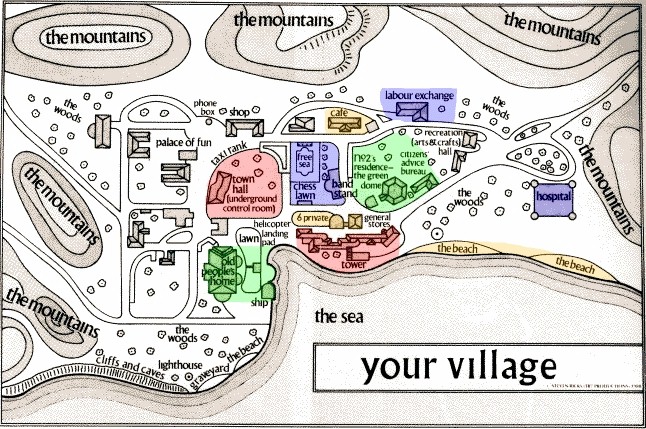
As you can see from the graphic and above notes, “Privilege” is the prompt for Day 9 of the RPGaDAY 2026 Challenge. And yes, I’ll be twisting this one as well. I didn’t really see an anagram or near-word. But there is a rhyming word, “village”.
So instead of making something up in this blog entry, I’m going to talk about one of my favorite locations that had its own unique characteristics. The Village from the surreal 1967 spy-fi British television series “The Prisoner”.
Short intro: Patrick McGoohan plays a British espionage agent who is kidnapped by persons unknown and sent to a place called “The Village”. The forces who control The Village want to know why McGoohan’s character (only referred to as Number 6) retired from his espionage assignment without giving a reason to his superiors. In The Village, Number 6 discovers that other prisoners in the gilded cage may also be “retired” secret service agents or possibly witnesses to things that should have not been seen.
When I started using this challenge to bring about the wonderful locations that are characters themselves, The Village was one of the best examples of this. When Number 6 is trying to gather information about his captivity, he is only given maps like the one above that are generic enough to prevent escape. There are hidden cameras everywhere keeping an eye on the inhabitants. If they wandered too far, special devices called “Rovers” would appear and incapacitate (or even eliminate) the offending individual. These “Rovers” appeared as a large white balloon that could herd or smother those that they tracked. It is not known if they were autonomous, semi-independent or just remote controlled.
The needs of the inhabitants were well taken care of in this cage with no bars. They were provided with an apartment, food, clothing and various entertainment options. There are stores, a hospital, recreational options, labour exchange, café, a town hall and even a phone box (no it’s not blue).
Some of the inhabitants knew that they were prisoners within this location. Others were participants in trying to obtain information from those who had been brought here. And there were others that no longer possessed all of their mental facilities.
The Village sits on a warm coastal location somewhere in Europe. In the show the exact location is a bit of a mystery. In one episode, it’s easy to get to from London. In another episode it takes a while to get there. This may have been on purpose as the bulk of the stories in this 17-episode season are mind-fucks (for lack of a better word). We are never told who controls The Village, the fate of the inhabitants or if Number 6 ever gets to be a free man. This vagueness has contributed to the appeal of the show. Fans could debate facts, information tidbits and theories about this series for years (and continue to this day).
This location begs to be used in a spy-fi espionage RPG campaign. While some GMs may enjoy watching the entire TV series, there are some other quicker options for additional information on this location. Both Wikipedia and The Prisoner Wiki have entries on The Village. And there was an actual RPG supplement released for it that I talked about in a 2021 RPGaDAY entry. Steve Jackson Games released GURPS The Prisoner when they had a massive expansion of IP related supplements. It was one of the few GURPS products I kept when I had an RPG book purge in the mid to late 90’s (I look back at that with regret). This supplement had suggestions on types of games that could be played, how to introduce the characters to The Village and a guide to the episodes. If you can pick it up, I’d recommend it.
“Be seeing you.”
What other locations have you seen that would provide a number of stories for a roleplaying campaign? Tell me about it. This article is open for discussion on the TardisCaptain dot Com Discord server. You can also email me at Carl (at) TardisCaptain.com or click on my social media links with any comments.
Day 8 Prompt: Resolve Week 2 Prompt: Intellect Weekday Prompt: Works Hard
Thank you again for the encouraging feedback you’ve all been providing for me. It’s making me feel that my efforts are being appreciated. For Day 8 of the RPGaDAY 2026 Challenge we were provided with the prompt of Resolve. I’m worried that this would be too generic (as a lot of these prompts seemed to be). So, I’m returning to my twisted world of morphing the prompt and I’ve come up with Resolute. Close to the original, but it got some creative juices flowing.
::Standard Telegraph Services Start:: From: T Finch Jr., Field Reporter To: Editor T Pembroke, Chicago Sentinel FORT RESOLUTE KAN JUNE 20 PART 1 OF ARTICLE SENT BY POST STOP FIRST ROUND OF INTERVIEWS COMPLETED STOP EXPECT PART 2 ARRIVAL IN TWO WEEKS STOP ADDITIONAL FUNDS REQUESTED TO COMPLETE ASSIGNMENT STOP ::Standard Telegraph Services End::
The following article appeared in Edition XXI Volume Four of the Chicago Sentinel on June 29, 1875. THE WILD WEST BECKONS SETTLERS, PART I Fort Resolute, Kansas June 20, 1875 By Thomas Finch Jr., Field Reporter for the Chicago Sentinel Edited by Theodore Pembroke
On the edge of the American frontier stands one of the last bastions of civilization that many travelers will pass through on their way to points west. The trail ends, and begins, at a lone U.S. Army fort in Kansas near the borders with Missouri and Nebraska known eloquently as Fort Resolute. In the two weeks since my arrival, I have encountered dust, winds, rain and the widest variety of humanity that I’ve had the fortune of encountering. Travelers stocking up at this military base before heading west. Their destinations could be the gold hills of California, driving cattle south to Texas and Mexico, or places in-between. Many souls are looking for new lives with religious freedoms, fair pay for an honest day’s work or even a new husband. The expansion of knowledge also brings travelers along this stop, both the highly regarded and the depths of the unknown.
For the price of a drink, an act of kindness, or an exchange of information, I was able to interview a number of individuals who made the temporary stop at Fort Resolute before moving on in their quests. Here is a short snippet of some of those conversations.
While the scar on the side of the face of U.S. Marshal Elija Boone may frighten some of the children he has come across, I found the calm demeanor of this lawman very pleasant. Unlike most of the individuals that I’ve met, Marshal Boone lacks the freedom of choosing his next destination. He had just arrived with a fugitive that will soon be tried in the local courthouse. Having a drink before heading out again, Marshall Boon informed me that “The law ends nowhere. It merely gets harder to carry.”
After assisting with a runaway horse, I was thanked by Sarah Whitaker and her four children. She told me that after her husband had passed away in the Appalachian coal mines back east, she decided to head west to provide a better life for her family. “Back east we rented the ground beneath our feet. Out here we’ll own it.”
Not all travelers were heading west from the rugged fort. I met a group of railway workers from the oriental land of China. Only their foreman, Chen Wei, spoke English. From our broken conversation he said that “A railroad is a promise made of iron. Every mile says the world will be smaller tomorrow.” They had worked on the western half of the new network of railways and were heading east to assist with the further expansion.
There were two sets of educated parties within the fort, but they seemed to come from different worlds all together. First was Professor Bernard Holloway of the Stanton Institute. He was more than happy to explain that “Every region leaves bones behind. Some of these bones are answers to the un-asked questions.” He was more interested in the supernatural legends and following up on leads of the paranormal. While I had my doubts about some of his theories, I gladly accepted his gift of a protection token at the end of our conversation.
The second learned individual came from the shores of England. Dr. Percival Finchhh, F.R.S. is a natural philosopher and explorer. Documenting the plants for possible medicinal use was his goal. It took some time to convince him that I was serious about my interview. “I came seeking fossils and unusual fauna. The Americans insist on showing me gunfights and violence.”
“The frontier does not create sinners. It merely removes the walls that hide them.” Was proclaimed to me by Reverend Josiah Cooper. What I found most interesting was the derringer that the good reverend kept hidden in a secret compartment in his bible.
A scout that went by the name of Runs-Between had told me of many wagon trains that he assisted guiding them to the Rocky Mountains. The proud Indian informed me that “Most people lost on the plains do not know they are lost until they run out of water.”
In Part II of my article has many more freedom seeking individuals ready to tame the rugged lands. Mormon pilgrims from Sweden, cattle drivers from Texas, a gambler looking to press his luck, brides who have only known their engaged partner by letter, a Canadian Fur Trapper looking for his last big score and many more. There are many souls that can be found walking through the gates at Fort Resolute, who will I interview next?
Did this get the dusty trails vibe? There are quite a few western RPG and scenarios out there for players and GMs. What suggestions would you like to see for a future blog entry? This article is open for discussion on the TardisCaptain dot Com Discord server. You can also email me at Carl (at) TardisCaptain.com or click on my social media links with any comments.
I’ve had some very positive feedback on my Day 5 entry of Burden or Burned and my Day 6 entry of Reach. One fellow RPG bloggers commented that these were some of my best entries so far. Then they recommended that I use the same format for a fantasy setting. Well for day 7 of the RPGaDAY 2026 Challenge the prompt is Mercy.
Should I use Mercy or should I twist it? Tick, tick, tick…… processing complete. The following system agnostic entry can be used for Dungeons and Dragons, Basic Fantasy, Castles and Crusades, Fantasy Age or any of the many other fantasy RPG systems out there.
Journal of Prengar Derreth, 14th day of the royal year 1267.
I did it. I can’t believe that I’m on my way to joining the Order of the Macers. I’ve completed my first day of orientation here at St. Carthan’s Fort. I really wish I could tell you where I was, but new initiates are hooded for the last three days of the journey. When they pulled the hood off of me and the other candidates in the courtyard it felt like a breath of fresh air. Sure, we could take the hoods off as we slept in the enclosed tent at night, but not seeing sun or stars for three days was disorienting. Seeing the ramparts and towers covered by the banners of the different house mantles was a sight for sore eyes.
There are five house mantles that make up the order. The Heads, which consist of leaders and future leaders. The Hafts, which consists of the coordinators and logisticians. The Flanges, those who are instructed to strike swiftly or silently when called upon. The scholars and researchers are known as The Crowns and finally The Pommels who are the doers who get things done. All parts of St. Carthan’s Mace that are equal in providing mercy and justice. A single mantle cannot do the job alone; thus, we are all brothers. This was one of the first lessons we learned on day one orientation. To be a member of the Order of Macers is to be trusted or feared in the many kingdoms that we bring justice to.
Soon I’ll go through my first set of trials. How I pass them and work alongside my fellow initiates will determine which mantel I will join. I’m not certain which one I really hope to be admitted to. I have many talents that I feel can contribute to the order. I guess this is why the trials are here, to make that determination.
I was not surprised to see the many races of the land represented in the order. Humans, Elves, Dwarves, Halflings, Orcs, Giantkin, Centaurs, Dragonborn, Touched and Goblinoid. All had passed the trials and deserved my respect. None looked at me with eyes other than, will I uphold the order.
Then over the next two years, I’ll go through several more different trials. Each harder than the last. While different proctors and teachers will guide me during the first year, I’m really looking forward to the time when I’m selected by a Warden of the Order to be their Aspirant. Assisting the Warden will be one of my many duties in the Order’s mission to provide non-partisan justice and guidance across the lands.
I remember telling my mother that this would be a difficult life. I may never see the wheatfields of home again. But if I’m able to protect those fields and the members of my line that work them, then it will be all worth it.
The nightcall is about to go out. This is a time of rest which I will gladly take. Tomorrow, I know that my orientation will continue. Will I be able to keep up with my fellow initiates in the trials? I pray that my body is strong and my mind stay sharp.
-Prengar Derreth, Order of the Macers Initiate (by the gods it felt good to write that)
If you guys are getting Jedi vibes, that was rolling around in my head as the muses spoke to me. An order of knights that carried special maces (like the Jedi carried lightsabers) that distinguished them from other fighting forces. Known for balanced judgement and mercy when called upon by the general population. Some kings have blessed them, while others have cursed them.
I hope the thoughts that got loose out of my head have helped inspire you. What suggestions would you like to see for a future blog entry? This article is open for discussion on the TardisCaptain dot Com Discord server. You can also email me at Carl (at) TardisCaptain.com or click on my social media links with any comments.