Posted in: Character Creation Challenge, Role Playing Games, Science Fiction

2026 Character Creation Challenge Day 27: The Terminator RPG

On Day 27 of the 2026 #Character Creation Challenge I’m going to use another game that you can’t pick up on DriveThruRPG any more unless you had purchased it prior to September 2025. The Terminator Roleplaying Game by Nightfall Games. According to the Terminator Fandom Wiki, the publisher decided to end their rights by mutual agreement with StudioCanal. I didn’t know that until now and it may have explained why the game came up for sale when I had purchased it on DTRPG. The link I posted above goes to an Amazon listing for anyone looking for a copy.

I’ve always enjoyed the Terminator franchise and thought it would make for a good RPG campaign. I even remember reading articles with what-if scenarios like: “What if the series 800 model 101 infiltrator unit was accidentally sent back in time to 1886 instead of 1986?” I think that is what I like about science fiction stories and games. The “what-if” factor. In this game, it appears that you can play resistance fighters in the future war, or those who have been sent back to the 1980’s (or other times) to protect the timeline.

So the PDF I own has 232 pages in it. It was written by Andrew E.C. Gaska who also wrote the Planet of the Apes RPG, The Alien RPG and I even had a chance to meet at a past FanX: The Salt Lake Comic Convention. As I was reading the rules, I could see some of his fingerprints in the system based off the in-person conversation that we had at the con. The character sheet is one-page long and the character creation process starts on page 30. There are seven steps in total (with an optional eight step that I will not be using) to create a character. I’m going to make a member of the resistance who will be sent back to the 80’s to find and protect a target from being terminated.

Step one is to select a role. This could be considered a class or archetype. Not everyone in the resistance is a soldier (but everyone fights where they can). The options are Engineer, Grunt, Hacker, Historian, Medic, Pilot (ground or air), Scout and Strategist (aka generals). I made a Drow Hacker yesterday with Modern Necessities, so I’m going to go with Historian this time. I don’t think I’ve made one in any of my past challenge entries. Each role gets some initial stats, skills and a resistance ability. I wrote these down for my yet-to-be named character.

Next comes the stat generation. These attributes are Strength, Dexterity, Knowledge, Concentration, Charisma, Cool and Fate (which I was glad to see in the game). They range from 0 (poor) to 6 (incredible). Some of these stats already have a score thanks to the role selected above. I’ve been given 7 points to spend on the other stats. There is a max stat limit for the different roles and a chart is provided. For example, with his brains, this historian could have a score of 6 in KNOW, but only a 2 in STR. I didn’t know if I should make him general (1 point in each stat) or specialized? I think this is why I don’t like point buy systems. I decided to go with 1 in each category and added it to my notes.

Step three covers the Hope Points of the character. According to the book, this represents the faith that the character has in their own abilities and in humanity. There are three categories for hope points, Body, Brain and Bravado which are associated with a stat (example Brain has KNOW and CONC). I add the two associated stats together and then the category with the highest number gets 2 Hope points (in this guy’s case Brain, and the second gets 1 and the lowest gets zero. Since there was a tie between Body and Bravado, I was instructed to pick one. Now I’m confused. Besides the three points listed above from the values, it says that I have 3 more hope points to spend in any category (max 2) how I want? Am I reading this right? Slightly confusing. But I think I have the 3 more points to spend so I wrote them down on my notes.

Skills are the next step in the creation process. There are skills categorized by the stat would use them (e.g. melee weapons falls under STR). The range is 1 (skilled) to 4 (Specialist) with the max at creation time of 3 (Expert). Each Roll has a list of starting skills that begin at the rank of 2. I’m then given 36 points to spend on any skills with a chart of how much it costs to go to each rank. Ugh, again I dislike point buy. Yea they are good if you have something in mind or are homebrewing, but for just general character creation, I’m not a fan. First I picked some minimal skills that I thought a resistance member would have surviving in a robot apocalypse. I was able to get them spent and added to my notes.

Step five is the Traits that give the character some personality and possible hooks for the Director. I have zero points to spend on the traits, but if I take a negative trait, I’ll gain points. I’m getting a GURPS vibe here of all the negative things to get a bunch of points (something I dislike). I looked over the costs and descriptions and honestly nothing really pulled me in. Perhaps if this was random or required. I finally broke down and picked one good and one bad trait and moved on.

For step six we are doing the Figured Stats. These are stats that are calculated by other items noted above. Most have mathematical formulas. These include Hit Points (health of body), Willpower (mental strength), Movement (closing and rushing), Encumbrance and Initiative. Luckily after the descriptions there was a chart with all of the baselines and formulas for me to use when writing down my character notes.

And the last step (for me) is to come up with the Finishing Touches. Name (William Harden), background (was raised in an abandoned library so that is where he gained his knowledge and equipment (discussed with Director if the game is set in the future or if they traveled to the past naked). He’s naked to start.

There is a step eight, which is for the players who wanted to beg their Director to let them play a cyborg or fated (aka targeted by Terminators) character. Since I’m not using this according to the voices in my head, I skipped it. Here is the character sheet after I transferred my notes to it.

Afterthoughts:

They had the Terminator 2 font everywhere in this book. I think it was giving me flashbacks because that was one of the original fonts that we loaded onto our computers to make futuristic newsletters and flyers.

I like how they gave a one-word description of the different stat ranks. This would make it easy to homebrew stats for someone that I could have ported into the game.

This game uses a pool of d10s to determine success. One of the d10s has to be different from the others and it must role above the target number in order for the additional skill die to count. I kind of raised an eyebrow at this wondering how it would play at the table. Some of the target numbers were higher than 10, but you do add some modifiers to the roll if I read the system section correctly.

I know it sounds like I did a lot of complaining above. My issue is with the min/maxing of point buys. I wasn’t a fan of them in GURPS, and I’m not a fan of them in other games. I feel that it drags out the character creation process. Sure if you already have an idea in mind (which I didn’t) then it may help. While I hated making GURPS characters, I didn’t mind playing GURPS at the table. I wonder if I’d feel the same with this system? I don’t know if I’ll get a chance to try unless someone runs a one-shot at a con.

Additional Notes:

I’ve had some participants ask me if there will be a badge graphic for those who complete the 31 characters as we have done in years past. The answer is yes, my artists has been working on one and has sent me several prototypes for feedback.

I had a blogger reach out to me by emailing Carl (at) TardisCaptain dot com to let me know that they were posting their entries. I’ve added Skeleton Soldier Press Blog to the list on the 2026 #Character Creation Challenge page.

Coming Up Next:

The One Ring

This article is open for discussion on the TardisCaptain dot Com Discord server. You can also email me at Carl (at) TardisCaptain.com or click on my social media links with any comments.

Posted in: Character Creation Challenge, Role Playing Games, Science Fiction

2026 Character Creation Challenge Day 24: EverReach

Last year I had the opportunity to talk with the game designer for the sci-fi RPG, EverReach at SaltCON. He offered to send me a copy of his game to use in a future blog post. He also gave me the freedom to review the game as I saw fit. So, I am using it for today’s entry in the of the 2026 #CharacterCreationChallenge. Now, I had a chance to play this game with the designer at a past SaltCON.

So the PDF book is 324 pages and was released by Laughing Gnome Games. The ISBN number is 979-8-9925886-1-3. EverReach uses a system called the Luck Die System. To complete a task the player rolls 2d6 and another d6 known as the luck die, add any bonuses from skill, equipment and traits and try to meet or beat a target number. The player has a series of luck points and can replace one of the d6s that they just rolled with the results of the luck die.

The steps to create a character are listed on page 14. Create a character concept. Assign abilities. Pick a Genotype (think race). Select a character background. Select bonus skills and background. Select the character’s talents. Pick up equipment. Build a ship and finally finishing touches. There are little sub-steps or different methods in each step.

Step one is the character concept. As I’m typing this, I’m watching episodes of my favorite science fiction comedy series Red Dwarf. So I’m going to make a human engineering character that’s a little on the slobby and lazy side. Step two is assigning the attributes. The attributes used in EverReach are Brawn, Determination (mental fortitude), Wits (awareness), Agility, Intelligence and Presence (charisma). There are three methods that can be used to generate the scores for these. Focused (pick one at 4, one at 1 and the rest are 2), Balanced (Two attributes at 3 and all others at 2) or Point Buy (spend 13 points among the six attributes). Since this guy is one of the lower deckers, I went with balanced.

Now to select the Genotype of the character. In this gaming universe there are Humans, Metahumes (weak psychic humans), Spaceborn (humans designed to live in space), Heavy Worlder (humans designed for working on heavy gravity worlds), Reptilians, Avians, Felians and Piscine (genetically modified reptiles, birds, cats and fish) and Androids. Considering I’m making my own version of Lister, I briefly considered Spaceborn or Heavy Worlder, but I don’t think that really fit the concept I was going for, so I stayed with Human. I get to up two of the character attributes by 1 and I get to add +1 to Luck.

Step four is the character background. Where were they born, what type of upbringing and career do they have? We also select two personality traits and a character flaw. Sticking with the Lister theme I’m making the character from the United Kingdom. So he has the language of English and the trait of European. For the upbringing I considered Criminal, Urban or Rural, but I decided to go with Laborer. I wrote down the traits, social network and background listed. After seeing the list of Careers, instead of going with Engineer that I was thinking above, I selected Deckhand since he was a lower decker. This gave the character his first set of skills (rank 2), another social network connection and an additional trait. For Personality I’m instructed to pick two from the list provided (went with Optimistic and Witty) and at least one Flaw (Claustrophobic). I could have picked a few others to match the inspiring character but I didn’t know if it would have provided any additional positive traits.

For the bonus skills and background, I get to choose three additional skills at rank 2, bump two of my rank 2 skills to 3 and then select five skills at rank 1. I also get to choose one additional background talent, one additional social network. Um… are the background talents under the Talents chapter or in the Backgrounds chapter? This is probably where I would have asked the GM if we were making the character together at the table. There is an entire chapter on different talent types, but they appear to be connected to certain skills. I’m going to go out on a limb and think its one of these in the talent chapter since I haven’t seen that come up anywhere else. Under the Mechanics Talents there is a Robot Ally (since Lister had Kryten). No, I’m wrong, steps six (the next one) has the rules for those talents. I guess I’ll just skip this one for the time being.

As mentioned above, step six is to select the talents of the character. Each skill that has a rank of three gets a talent. Since Mechanics is at skill level 3, now I can take the Robot Ally talent that I had mentioned above (Welcome to this character’s Kryten). Since only one other skill was at a 3, I picked a talent for Subterfuge (Disguiser).

Equipment is the next step. The rules state that the character has a a choice of three equipment items that are always in their possession. There are other items that can be used during the game, but these three things appear to be signature items. I think I just pick three things that are not large and bulky.

Step eight is Building the Ship. Work with the crew (other PCs) including who owns it, who does what on the ship etc. Sticking with the Red Dwarf theme, I’m certain that this character has a small mining scout like StarBug 1 that’s owned by the company they work for. There is a whole set of steps just to design the ship. I’m not going to go into on this blog post because it’s already getting to long as it is.

The final step is the finishing touches. This includes determining speed, armor, shields, health, etc. It’s done by various mathematical formulas provided. I was confused by the second sub-step in finishing touches. It says to add the attribute bonuses+2x skill ranks to determine the bonus for your skills. But when I do a Ctrl+F on the document, nothing else comes up for attribute bonuses. I haven’t given a name to the character yet, so I’m going with Charles Craig. Glorified space bum who’s only working before he gets his big break (and hopefully the girl of his dreams) to retire on a farm on Fiji. I transferred everything to the two-page character sheet and scanned it below.

Afterthoughts:

I was wishing that the chapters and layout describing the characters was in the same order as the character creation steps listed on page 14. I was jumping all over the place in the PDF. It would have been helpful in the step-by-step guide to say (see page x for more information). Another issue was the AI images. They had the usual issues of merging body parts, plastic skin and more. Like the Vintage Space RPG that I had used in a past Character Creation Challenge, none of the images seemed to be related to each other other than being in space. It was really distracting.

Now usually when I create a character for the challenge, I usually say “I wonder how it plays at the table?” Well, as mentioned above, I was able to play it in a convention one-shot. We did a lot of pre-planning for our raid into the facility we were hired to break into. When we got to tossing the dice, I don’t recall thinking anything like “that didn’t work” or “that seems to be too steep for a success ratio” like I had in some other games. So with a good GM and players, this should be a game that can be used in a campaign. The GM is encouraged to develop house rules for their table if needed.

I would also like to point out, that in the same vein as Chris Gonnerman, Bill Logan, Mark Hunt and more, Patrick Buckendorf has done something that I want to do. Write a roleplaying game and get it out into the wild. Like others, I say I want to do it. But the actual act of getting it done and out is a major accomplishment that I hope to achieve some day.

Additional Notes:

In the 2025 #CharacterCreationChallenge the proper Top Gear crew came up in several characters. This year it appears that Red Dwarf is inspiring some of the characters that I end up using. Even if it’s towards the end of the creation process.

Coming Up Next:

The Walking Dead

This article is open for discussion on the TardisCaptain dot Com Discord server. You can also email me at Carl (at) TardisCaptain.com or click on my social media links with any comments.

Posted in: Character Creation Challenge, Reviews, Role Playing Games, Science Fiction

2026 Character Creation Challenge Day 22: vs D.A.M.N.I.T.

The game that I’m using for Day 22 of the 2026 #Character Creation Challenge is one that I backed on KickStarter. Because of how far behind I’ve been, I haven’t had a chance to write a blog post about it. So this will count as both. The game is called Dwarven Assault Mining And Neutralization Interception Team (D.A.M.N.I.T.) and is a sci-fi game about Dwarves in space. The characters are a part of a trouble team sent to clear dangers out of various space mining locations or fighting pirates. When I read the description it sounded like fun, and they weren’t asking for too much on pledges. There have been a few KickStarter campaigns where the game sounded interesting, but I didn’t want to spend to much for a game that I may only play once or twice.

The physical copy of the game I received has 34 pages, but the PDF extras added several pages more. One of the extra rewards was a 5th Edition version of the game if I elected to play it. For the challenge I’m using the creation rules for the original game. The book has an ISBN number of 2-370021-779178 and was written by Mike Lafferty and Chuck Rice. There is a ton of color art in this book by Jacob Blackmon, Jon Gibbons, Dean Spencer, Kristin Nokes and Rick Hershey.

This is a rules-light system for quick play between players and DM (Dwarf Master). There is a target number and the player rolls a d20 to see if they meet or exceed the TN. The advantage/disadvantage rule is in play within this system. From the looks of things, this is one of those games that I’d pick as my odd-ball one-shot to run at SaltCON. I’ve got a few to set up for the next several conventions since they run three of them a year.

There is a one-page character sheet. The character creation steps are provided in a separate PDF when you pick up the game from DriveThruRPG. There are seven steps in total to get a character ready for the table.

Step one is to pick a class from one of these options. Scout, Medic/Science Officer, Heavy Weapons/Pilot, Engineer or Dwarven Earth Alchemist (DEA Agent). This last class is a special alchemist that can also cast spells. While this last one sounds interesting, I’m eyeing the Scout since he is an infiltrator. The book states that all characters get 15 HP to start, a specific attack and three fixed skills.

The second step is an optional one if your Dwarf Master allows. Picking a personal skill to make the character different from the others. I randomly picked one from the list since the voices in my head said to do so.

A Perk is a unique ability that the character has. For step three, I’m instructed to pick one from the list that I thought would fit this unnamed character.

Steps four and five both deal with gear. Allocating gear points then buying said gear. 10 gear points is allocated per character. I decided to pick both a ranged and melee weapon (I was surprised that there wasn’t a dagger option).

Picking a name and background is step six. I used the online random dwarf name generator to dub this character: Hezan Copperhood. After his brother went missing on a previous D.A.M.N.I.T. team, he signed up to find out what happened to his kin, and dispense justice if needed.

And finally step seven appears to be another optional one as well. If the Dwarf Master give their OK, then make your own custom skill, perk, gear or spell. I like this idea that gives the player a chance to contribute something. I’m going to go with a family heirloom which turns out has a special function. The Ancestors’ Ring. This alien technology discovered by one of his forefathers on an exploration mission can cause silence for two rounds once per game. Do you think that the Dwarf Master would allow it?

After reprinting the character sheet (see below) I was able to scan it to wrap up this blog post.

Afterthoughts:

When I went to transfer my notes to the character sheet, I realized that I had accidentally printed out the sheet for the D.A.M.N.I.T. 5th edition game. So I quickly printed out the original character sheet if you are wondering why it looks different from the photo at the top.

I hope I did the gear right. I spent all of the equipment points before I realized that I could make my own special item at the end of the process. So I may have too much gear on this guy.

This game looks simple and straight forward. My games for the spring SaltCON are already locked in, but I wouldn’t be surprised if I try to run this for Summer or End-of-Summer SaltCON later in the year. I’m very happy that I backed this Kickstarter.

Additional Notes:

This is my third of four games used in the challenge that I had picked up from KickStarter over the past year. I should go back and count how many KickStarter games I’ve used over all of the years of doing the #Character Creation Challenge.

Coming Up Next:

Swords & Wizardry

This article is open for discussion on the TardisCaptain dot Com Discord server. You can also email me at Carl (at) TardisCaptain.com or click on my social media links with any comments.

Posted in: Character Creation Challenge, Red Dwarf, Role Playing Games, Science Fiction

2026 Character Creation Challenge Day 19: Rocket Age

Day 19 of the 2026 #Character Creation Challenge and I’m using a pulpy science fiction RPG that I had picked up in a charity bundle sale years ago. This game was published from Cubicle 7 called Rocket Age. It has Humans exploring the solar system with adventures on Venus, Mars, the moons of Saturn and Jupiter and more with a 1930’s attitude. It appears to be similar to the Doctor Who RPG that this same publisher released. Let’s dive in to see.

There is a one-page character sheet. The character creation rules are found on page 94 (after a TL/DR intro into the game universe) with a total of 257 pages for the core book. A summary is listed on page 95 and has four steps.

The first is what type of Sophont is your character. Well this is the games fancy term for race. My choices are Earthlings, Eurpoans, Ganymedians (both of these are from the moons), Ioites (a race that had their homeworld blown up by the Europans), eight different types of Martians (gee, I wondered what inspired this) and Venusians. I’m keeping it simple and sticking with Earthling. I’m told that I have 42 character points and the cost to be an Earthling is 1 of them. This also gives me the attribute modifiers and traits for Earthlings which I wrote down in my notes.

Step two is the occupation of the character. I looked at the choices and they are Citizen, Diplomat, Explorer, Merchant, Military, Miner/Scavenger, Native, Scientist, Law Enforcement, Europan Emissary, Deutsche Marskorps War Walker Pilot (Nazi cyborg mech drivers on Mars who left the service), Martian War-Priest, Rocket Pilot, Rocket Ranger and Venusian Harvitioi (wandering Venusian). Well the non-Earthling options are out. Again, keeping it simple, I selected Rocket Pilot which cost me 11 character points. I wrote down the attributes, skills and traits listed for this occupation in my notes.

On step three we now take the remaining character points (of which I have 30) and spend them on Attributes, Skills and Traits. Some of these have already been added from the first two steps above. The Attributes for a Rocket Age character is Awareness, Coordination, Ingenuity (aka Intelligence), Presence (aka Charisma), Resolve (aka Willpower) and Strength. These were the same in my Doctor Who RPG first edition entry. Also the same was the skills each character has. Athletics, Convince, Craft, Fighting, Knowledge, Marksman, Medicine, Science, Subterfuge, Survival, Technology and Transport. Traits are good and bad things about the character. The bad traits can give you back character points to spend elsewhere. I spent my points trying to make an Ace pilot.

What a guy.

The last step is the character’s story. What is their name and do they have a nickname. Pulling from one of my favorite shows, I’m going with Arnold “Ace” Rimmer. The image of the silver suited pilot from the Red Dwarf popped into my head. His friends are… well you know (or should know). The book also says that equipment is picked in this step. It just says, look at the equipment section and pick the reasonably logical items. It already stated that there was a ship connected to this character in one of the above steps so I’m marking that down as well. This looked like it was both vague and too much in some sections. So I’m going to skip it (other than I already wrote down the silver leather jacket and the ray gun). Here is the character sheet after I transferred my notes over.

Afterthoughts:

I repeat myself. Rule book first, lore second. Rule book first, lore second. When a gamer picks up an RPG book, they can (usually) tell from the cover what genre of game it covers (fantasy, sci-fi, horror, etc.) They want to know “How do I play it? How do I quickly explain it to my friends to try to get them to play it?” If you can’t do that near the front of the book, then most gamers are going to use a system they are already familiar with and adapt your lore for what they want. The lore did sound a little interesting from what I skimmed through, but I didn’t take a deep dive into it as I wanted to learn the system.

The bookmarks in this PDF were… weird. I finally had to go to the index and find the page number and tell my reader to go there. That’s when I realized I was skipping over 90 pages of fluff.

I had picked up this game because it was cheap in a bundle charity sale (I don’t recall which bundle service it was). But at the time I was thinking homebrew. Now…. I’m not certain. It’s pretty much fleshed out. The system is pretty simple (that I recall from playing the Doctor Who RPG). Roll 2d6 and add the attribute and any skill or trait modifiers to reach a target difficulty.

Had I known that I was going to make this character into Ace Rimmer, I might have adjusted some of the attributes and skills to make it more like him. But I didn’t want to go back and change anything. So don’t think this is my 100% interpretation of Ace Rimmer in Rocket Age.

Additional Notes:

I kept wondering why I had the thoughts of a Mallard character who was a Mage for my Dragonbane entry in the 2026 #Character Creation Challenge. Then it dawned on me that I had shared this video online years ago and I had to find it again. At the time I was thinking of my D&D 3.5 magic user in the last big campaign I played in.

Coming Up Next:

vs Ghosts

This article is open for discussion on the TardisCaptain dot Com Discord server. You can also email me at Carl (at) TardisCaptain.com or click on my social media links with any comments.

Posted in: Character Creation Challenge, Role Playing Games, Science Fiction

2026 Character Creation Challenge Day 17: FTL Nomad

On Day 17 of the 2026 #Character Creation Challenge I’m using a game that I had originally intended to use last year. I had it on the list and I believe I even had the character sheet printed out. Then a friend had gifted me one of my holy grail of RPG collectables that I had been trying to get my hands on. A copy of Red Dwarf The Roleplaying Game. It was late January and I had already done most of my challenge entries. So I looked at the list and originally I was going to bump Mazes and Minotaurs, but that game had already been bumped several times. So I bumped FTL Nomad since I would be swapping one sci-fi game with another. When I schedule out my games, I try not to have two of the same genres next to each other.

So what is FTL Nomad by Stellagama Publishing? My initial thought is it’s a retro-clone(ish) game of the Traveller 2d6 system that contains some modern rule ideas such as advantage/disadvantage dice. The universe is set as a near future cyberpunkish interplanetary setting which can be expanded to interstellar. I’m sure there is more to it than that, but that was my first impression. Stellagama Publishing also put out several other titles that I’ve used in past challenges including The Sword of Cepheus 2nd Edition, Cepheus Deluxe and more.

The PDF of the rulebook has 277 pages and our character creation summary starts on page 14. The character sheet only has one page. Let’s dive into this system and see what we can come up with.

Step one is the character concept. Since I’m keeping this simple and easy, I’m going to make up a hot-shot human pilot. Yes there are aliens in this game, but I’m sticking with human. As a human (as detailed in step two) I get to distribute five points among the seven skills that are all currently at zero. As a starting character none of these can have a score more than three. The skills listed are Combat, Knowledge, Physical, Social, Stealth, Vehicles and Technology. Pretty self-explanatory.

Step three is to pick an Archetype (aka class or basic concept of the character). As mentioned above, I’m already picking Pilot. But the other options were Agent (spy, bounty hunter, troubleshooter, etc.), Diplomat, Engineer, Merchant, Mystic, Outlaw (pirates to con artists), Outsider (barbarian, exile, etc.), Roughneck (workers in space), Scholar (doctors, scientists and more), Scout or Soldier.

Since this character is human, on step four I get to pick a Talent or special ability. These were in three categories of combat, character or professional. I found one for Ace Pilot and wrote it down in my notes.

Next comes calculating the Stamina. This was a mathematical formula with any bonuses from the Physical skill (which I had at one). The next step (six) is calculating the Encumbrance that the character can carry. Another mathematical formula also involving the physical skill.

Now we are purchasing equipment for this currently unnamed character. Hey, I get to roll something. 2d6x1000 for the number of credits he has. Now I can go to the equipment list or go pick an equipment package that is based around the Archetype. I’m going to go with the later as to not take up too much time. I wrote it down on my notes and subtracted the cost for the package. Actually I am going to take a peak at the equipment to see if there is anything else I think he should have. I did add a few more items that I thought the character would need.

The last step is to finalize the character. Name- Marcos Tryladar. Appearance- Good looking with short black hair and brown eyes. Trying to see if he can meet the next piloting challenge and left home to find his fortune. Let’s see how this looks when I transfer my notes to the character sheet. There are some blank spots that should be easy to fill out with a GM such as languages. But there is one glaring thing I noticed. There’s a Hero Points section. Quick search of the PDF shows that they are tucked all the way down on page 31. Each player starts with two and can be used for re-rolls or to activate special talents or abilities. That would have been nice to know before I had filled out the sheet.

Afterthoughts:

I really like the fact that this book gave us the basic mechanics and a rundown of the attributes at the very front of the book. I’m really disliking the publishers who follow the online recipe formula where they give the TL/DR story of whatever before they get to the actual instructions we are looking for. Remember, a core rulebook is a source of information, make that information easy to find and people will be more likely to play your games.

Being a Sci-Fi fan, I could see myself playing FTL Nomad. I don’t know if I will because I don’t even know any one local who plays Traveller, let alone any games based off of the 2d6 system. I’d love to try it just to see how it plays at the table. It’s generic enough that I could see some some homebrew possibilities for it.

Additional Notes:

After the flub with the Six-Shooters & Wagons the other day, and with a very busy schedule coming up (more family responsibilities that come first), I’ve actually sat down and scheduled out the rest of the month. Before today I had been winging it to give it a little bit of spontaneity. Let’s see if this pre-planning will help the rest of the month go smoother.

Coming Up Next:

Dragonbane

This article is open for discussion on the TardisCaptain dot Com Discord server. You can also email me at Carl (at) TardisCaptain.com or click on my social media links with any comments.

Posted in: Character Creation Challenge, Humor, Role Playing Games, Science Fiction

2026 Character Creation Challenge Day 16: Paranoia “Perfect Edition”

The computer is your friend. The computer wants you to be happy. Friend computer says the last Paranoia entry in the challenge was in 2022. So for Day 16 of the 2026 #Character Creation Challenge I’m instructed by friend computer to use Paranoia “Perfect Edition” (aka The All New Shiny Edition) that was released by Mongoose Publishing in 2023.

For those of you not familiar with Paranoia, it is a role-playing game that is set in the future where humanity lives in a computer controlled Alpha Complex. No, this is about the future not about today. The central computer controls everything and is trying to keep you safe from conspiracies, communist plots, secret societies and enemies of the computer. Why do you keep asking if this is a game set in modern times? Your character is a troubleshooter for the computer trying to discover the hidden fiendish plot that is about to be sprung upon your paradise-utopian society. All while trying to hide the deep dark secret that you harbor from other troubleshooters. No, I’m tired of that question. The computer says we should move onto character creation.

Of the 146 page PDF that friend computer instructed me to purchase last year, the character creation can be found on page 20. It is broken up into four steps (A-D) with sub-steps in each one. Friend computer is organized very well.

In Step A we are instructed by friend computer to create some PII (Personally Identifiable Information). This includes a punny name which is based upon the character’s clearance level (R for Red) and where they are from TOT section of the Alpha Complex and what clone this character is (starting is 1), so his name is Todd-R-TOT-1. Friend computer gave me a traitor star saying that if I have to explain the joke, it’s not very funny. Next I have to select the Service Group for Todd-R-TOT-1. After looking over the computer approved list, I selected PLC, which has the glorious purpose to create and distribute items including food. Button, button, who’s got the button. Each character has two buttons for Violence and Treason that is observable. I looked at the ideas that was presented in the book and selected two that I think would make friend computer happy, because I want him to be happy as well. Sub-step 4 are items that will be assigned by the GM at the start of the mission (Team Name and MBD).

Step B according to friend computer is to set the skills and stats for Todd-R-TOT-1. Gun Skills is an automatic +2 to hit the fleeing Commie Mutant Traitor. However on sub-step six, I run into a problem. I tried to tell friend computer that I was creating the character by myself, but friend computer states that we should stick to the rules. Because without rules, everything would descend into chaos. So one player (me) picks a skill (not guns) and assigns a +1 to it, the player clockwise to them takes a -1 in that same skill. This continues clockwise until all players have a single +1 and -1 skill listed. I picked a skill for Todd-R-TOT-1 and then since I was clockwise to myself, I picked a different skill to be a -1. I think friend computer is happy with me? I didn’t get any additional traitor stars or zapped with a laser. Next another player (uh, me again) picks a skill and makes it a +2 and the character that is clockwise gets a -2 in the same skill. This will continue up to +5/-5. I randomly rolled 2d4 to come up with the rest of the skills to simulate a group of players at the table. Once this was done, friend computer said to generate the four stats of the character (Brains, Chutzpah, Mechanics and Violence) look at the skills under each category and give it a +1 for each positive skill.

We are being naughty for Step C and we focus on the other character sheet. Not that we would do anything like that to our friend computer. But when he’s not looking, we pick a Secret Society from the list. Any of them sound dastardly, and since there are twelve of them, I secretly rolled a d12 and let fate decide Todd-R-TOT-1’s Secret Society which is [REDACTED]. Todd-R-TOT-1 also has a mutant power according to a table of 15 choices. No, I did not make a random roll and I did not write down [REDACTED]. The next two sub-steps apply the Service Group skill modifiers then the Secret Society skill modifiers.

Friend computer is wise because Step D is titled “Finish Up Already” and provides the final details to write down on the character sheets. This includes Moxie, XP, and gear. Everything that I’ve been instructed to write down is now on the sheets. But if I scan them, then friend computer can see my naughty side. Ah, friend computer says that the user agreement confirms that my naughty side will remain hidden and not fed into the AI learning module by a large corporation. I trust friend computer and scanned the character sheets.

Afterthoughts:

I loved how the four sections of the public character sheet had different ways of displaying the part numbers. Little details like that made me smile.

After re-reading my 2022 entry for the 2nd edition of this game, I can see where I got frustrated. Here the only snag was trying to do this by myself. This sounds like a perfect pick-up game or a one-shot played at a convention. I’d love to play in one for this edition at a con (hint, hint).

Additional Notes:

In response to my blog entry for Worlds Without Number, Sharrow on RPGPub responded with this helpful information. “For what it’s worth, focus picks are from the foci list (foci being the plural). Also, your dude should have gotten three: One ‘Any’, one ‘warrior’, and one ‘expert’. ‘Warrior’ means any that the GM agrees should count for a warrior, and ‘Expert’ means any non-combat, pretty much. In my experience, Adventurers who are Expert/Warriors start very strong, but drop back compared to pure Warriors at fighting over time (the Warrior’s Killing Blow ability get really nasty, as it also applies to shock damage). I’m not sure how a pure Expert would compare, as Masterful Expertise doesn’t seem as strong as the Warrior’s two abilities.” So I did mess up on the character. Good to know.

To the person who ordered something from one of my DriveThruRPG sponsored links, thank you. The credits earned will be used to pick up games for future challenges.

Coming Up Next:

FTL Nomad

This article is open for discussion on the TardisCaptain dot Com Discord server. You can also email me at Carl (at) TardisCaptain.com or click on my social media links with any comments.

Posted in: Character Creation Challenge, Role Playing Games, Science Fiction

2026 Character Creation Challenge Day 14: Worlds Beyond

For Day 14 of the 2026 #Character Creation Challenge I’m using a game that I had seen advertised in Dragon Magazine back when I had a subscription to it. It was one of those side-bar advertisements that looked interesting, but I never had the money to order. Well, thanks to this day and age of the legal purchases of PDF games, I was able to pick up the 1989 RPG Worlds Beyond by Precis Intermedia.
This game appears to be a sandbox sci-fi system that encourages the Gamemaster to borrow from SF sources such as The Foundation books, the Alien movies, The Stainless Steel Rat, Ice Pirates, Battlestar Galactica, Forbidden Planet, Starship Troopers and much more. It appeared to be in the same vein as Star Frontiers and Traveller.

So instead of making a character, for Worlds Beyond, you make a Citizen and fill out a Citizen Profile Sheet. The steps to generate one of these starts on page 5, but are listed as steps A through L.

In step A, I’m instructed to generate statistics for the adventurer by rolling 4D6 and discarding the lowest roll and then assigning the results to a stat. There is also an option of rolling 4D10+90 to generate a total number of points that can then be allocated. I’m not a fan of allocating in general character generation, so I’ll stick with the first method. The nine attributes are Intelligence (INT), Leadership (LDSHP), Sensitivity (SENS), Dexterity (DEX), Agility (AGL), Physical (PHY), Health (HE), Size (SZ), and Appearance (APP). Leadership appears to be like Charisma, and Sensitivity conveys the character’s observation skills. There is a good Statistic Measurement Table on page 8 which gives descriptions for the different levels present in each statistic. Illiterate intelligence, or Nimble Agility, etc. This would be good for homebrewing. I rolled the stats for the character.

Step B is to select the race of the Citizen. There are four available races presented in the book. Human (mostly harmless), Dolf (think religious Ferengi that look like lizards), Sher’tazi (Arrogant tall grasshopper hermaphrodites with multiple arms and legs) and the Swarr (A prideful humanoid cat race that lives in clans). Each race has its own max level for the attributes and some attribute adjustments. I selected Swarr since I’ve always liked cats.

Step C is the occupation of my Swarr character. I looked over the description of the race and there was one clan that hired out as mercenaries, so I selected Merk. The other occupation were Adexec (business bureaucrats), C-Tek (Computer techs), En-Tek (Engineers), Med-Tek (Doctors and scientists), Monitor (spies, assassins and bounty hunters), Spacer (pilots and smugglers) and Startraders (merchants).

The physical statistics are step D. The hit points, healing rate, etc. I followed the mathematical formulas presented in the book and wrote them down. It wasn’t mentioned (at least in the character creation section) if I should round up or down on the formulas, so I guessed it was rounding up.

Step E has us determining the agility skills such as movement, lift, throw, etc. More mathematical formulas are presented based upon the characters agility, dexterity and more. Once these are calculated, I’m also instructed to times the PHY score by four to gain some additional points that I can allocate to any of the agility skills.

For Steps F and G we are instructed to determine the maximum level for the character’s skills. We add the prime statistics for the character, then divide by four to get the average. This average is then multiplied by five to get 70% as the maximum skill scores. The associated skills start with a base from the INT score, so 13%. I have a 130 points to distribute to the associated skills. So, the skills that are not associated, do I get them at the formulas listed on the character sheet? I could have used an experienced GM here to ask. I think I got my skills in.

Combat skills are generated in Step H. There is also a max skill level on this as well which turned out to be 60%. The Merk is an expert in weapons and a master in the unarmed combat skill. I think I’m supposed to just choose the weapons (the rules were not very clear). I’ll pick some when I look at the equipment section later. I also calculated the Defense Factor.

Step I: Character age and life experience points. The older the character is, the more experienced they are. However the older characters start to lose statistics. To determine this, you can roll 4D10+30 or just pick an age 21 or older. This is where I’d probably talk with the GM to ask what type of campaign they were going to run. Since the voices in my head aren’t talking right now, I’m going to go with Inexperienced (age 21-40) and randomly pick 25. It was listed that the Swarr lifespan is 119 years. For every year past 21, I have 5% that I can add to any of the skills.

On Step J we pick three personality traits. These can be based upon descriptions found in the racial descriptions, or just chosen. I think I’d probably determine these during play. There is also a discussion on reputation, but not much on how it’s determined. Um, again determined during play since there is not much for a 25 year old character. Step K determines the character’s remaining luck. Add all of the prime statistics and that’s the luck base and then subtract half the character’s age from that number. This is a percentage number.

Now we are at the starting money and equipment for the last step (L) and I’m starting to lose a lot of steam. We roll a D4+2 to determine the number of digits in the bank account. Ok, that’s different. Next we roll a D10 five times and that’s the total in the bank. Really different, but my total is 41,554 credits. Then there is a list of starting equipment. So, do we get these already? I think so. I’m really reaching the end of my rope here.

Technically the character is done, but the book has a series of charts for the character origins. While they look interesting, I’m not going to go through them since I need to move on. Oh, a name? Yirr’baun was selected. I made sure everything was on the sheet from my notes and scanned the two pages.

Afterthoughts:

I can tell this is an older publication. There were signs that the editor should have gone through it once more before going to publication such as the “See character species profiles starting on page xx.” mistake. There was also a math issue when describing some of the skills from the attributes. The first one for INT, it was written that we use a x4 modifier to get the percentage score. But on the examples for the other attributes, they were all x3. So, which is it? Also there should have been a chapter describing the different skills. This still took quite some time to get the character done and I could tell I was losing steam at the end.

When describing the different occupations, I liked how the writer used examples from different movies and books. That is something that I’d probably do myself when writing a description.

The system is percentile with a roll the score or below. I understand this as FASA Star Trek was also percentile. When adding a little to this and a little to that on the skills I was also getting a flashback to creating a FASA Star Trek character. While I would probably enjoy this game, I doubt I’d ever get a chance to play or homebrew for it. I wonder how it would do if a second edition was ever released?

Additional Notes:

In response to my Tales from the Loop entry, I had a reader offer to run me through a one-shot. I’m seriously tempted by this just so I can learn more about the system.

Another response on the RPGGeek message board agreed with my Star Wars 2nd Edition comments about it being all over the place.

Coming Up Next:

Worlds Without Number

This article is open for discussion on the TardisCaptain dot Com Discord server. You can also email me at Carl (at) TardisCaptain.com or click on my social media links with any comments.

Posted in: Character Creation Challenge, Science Fiction

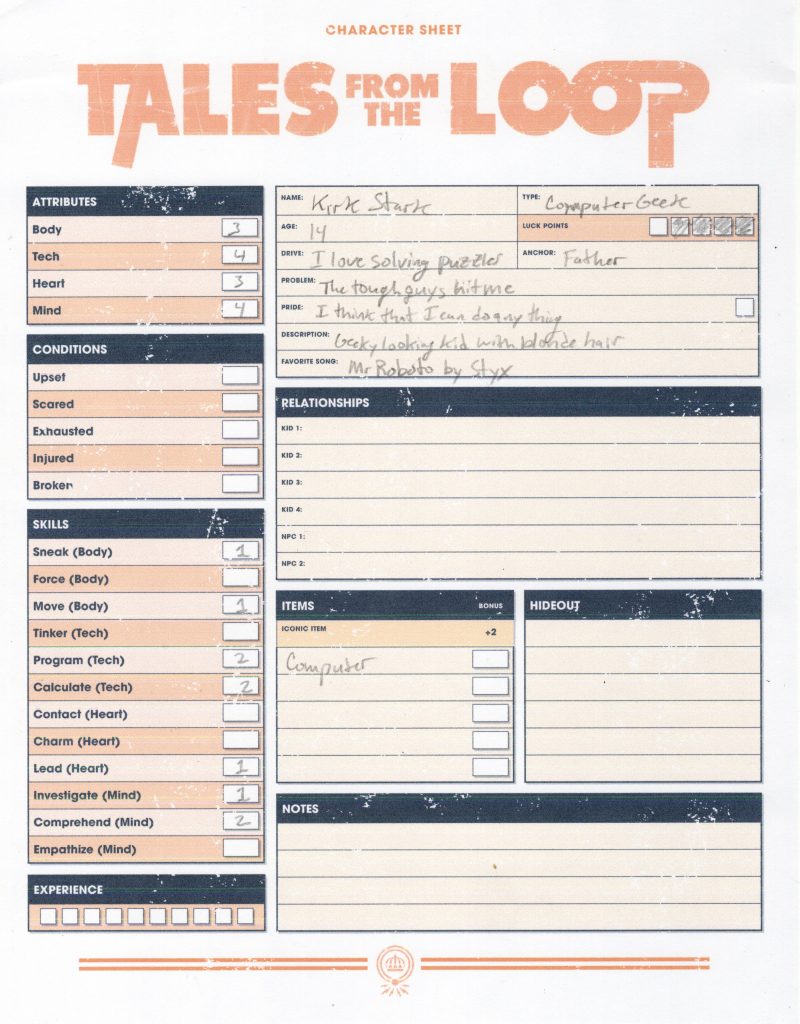
2026 Character Creation Challenge Day 10: Tales from the Loop

Day 10 of the 2026 #Character Creation Challenge and we are looking at Tales from The Loop: Roleplaying in the ’80s that never was. I was able to pick this book up as one of my thank you gifts from GMing at SaltCON. Three of the games that I’m using for this year’s challenge came from volunteering or connections at that convention. So, thank you to all of those involved and to the contacts that I’ve made.

For those of you who haven’t heard of Tales from the Loop, it’s based off a series of sci-fi paintings done by Swedish artist Simon Stalenhag. These paintings showed life in an alternate timeline 1980’s where robots and weird science was prevalent (usually with lots of kids watching them, hence this is a game about kids in this alternate timeline). These paintings were then put into a book, and eventually the RPG and even a TV series on Amazon. When I had a choice of which RPG book to take as a reward, the allure of gaming in the 80’s appealed to me. This is also one of the many Free League games that I’m using in this year’s challenge. Previously I had created a character for Twilight: 2000 4th Edition.

The hardbound RPG book is published by Free League that also publishes Alien, The One Ring and more. It has 191 pages and was written by Nils Hintze and uses something called the Zero Game Engine. I believe this is the same one that I’ve played when I had a chance to sit at an Alien one-shot at SaltCON. On page 49 it talks about the character creation process where the player makes a Kid. There are fifteen steps in total with the last two done with the group playing at the table.

Step one, selecting the Type of Kid you are playing. This is the class of the character. The options are Bookworm, Computer Geek, Hick, Jock, Popular Kid, Rocker, Troublemaker and Weirdo. Something tells me that I’m going to base most of this character on me in the 80’s. I wasn’t popular, or a jock (not without trying) or a hick. I wasn’t wild enough to be a rocker (but I loved the music). Of the remaining, I think that Computer Geek probably fit the younger me the most. Each Type has a set of key skills and I get to choose something for the following categories. Iconic Item, Problems, Drive, Pride, Relationships to Other Kids, Relationships to NPCs, Anchor and Name. There were examples listed for these categories that I could choose from or come up with something on my own. I wrote down my choices on my notes.

Selecting the age is step two. The book recommends between 10 and 15. I went with the age of 14. I’m also instructed to select my birth-date, so I selected a random one. A few sentences down I discovered that once the character turns 16, they are no longer a Kid within the game and are out.

Step three and we are at the Attributes. There are four of them that include Body, Tech, Heart and Mind and will have a score between 1-5. These represent the number of dice you roll when using the attribute. The number of points to spend per attribute is the character’s age. Every year on their birthday, they get one more point to allocate until they reach the “out-of-game” age of 16. I wonder why 16 is this cut-off age? I could see 17 or definitely 18, but 16? Oh well.

The next step is determining how many luck points the character has. Take the character’s age away from 15 for the total. So in this case he has 1 luck point. Apparently because the older kids are better with their attributes they don’t need the luck as much as the younger kids. When he turns 15, he will have zero luck points.

Skills is next on the list to create the character. “You know, like nunchuck skills, bowhunting skills, computer hacking skills… Girls only want boyfriends who have great skills.” OK, that’s just a quote from Napoleon Dynamite. But it was the first thing that popped into my head when I started reading next item. Each attribute has three skills (some were already listed when I selected the type) and can have a score between 0-5. If the skill can be helpful when I’m rolling the dice vs Trouble, I can add the number of dice listed in the score. I have ten points to allocate between skills. The key skills can have up to 3 points allocated, with other skills capped at a maximum of 1.

The next series of steps I’ve already completed when I selected the character’s type. The Iconic Item (step 6) is the computer. The Problem (step 7) is “The tough guys hit me.” The Drive (step 8) is “I love solving puzzles.” And the Pride (step 9) is “I think I can do anything.”

Steps 10 is about relationships that the character has. With the other characters in the party I selected “We are best friends.” Obviously this step would need to be talked about within the group of players (just in case someone wants to have their characters be siblings). The second one is relationships with NPCs. It had some examples in the book that I wrote down, but as I’m reading the later section on this, it really should be done with the GM who has set up the NPCs. But some of the examples included “The strange scientist, Diane Petersen, is my aunt, but that doesn’t mean I like her.” or “My friend Leeanne told me that strange creatures have moved into the Cooling Towers. She thinks they are aliens.”

On step 11 I get to decide who the character’s Anchor is. this is someone that you can go for support, comfort and care that’s not another kid. I picked one of the examples for simplicity and selected the character’s father. And apparently I’ve already completed step 12 earlier when I came up with the character’s name. I altered my name slightly since this is an alternate 80’s world. Kirk Stark. For the description (Step 13) I’ll probably describe my geeky 80’s self. The last step before the group decisions is “Pick the character’s favorite song.” Ah man, how do I pick just one song. I bounced between “Our House” by Madness, “Sweet Dreams (Are Made of This)” by The Eurythmics before selecting “Mr. Roboto” by Styx.

The last two steps need the GM and other players to complete. So I won’t go too deep into them here but they consist of “Where is the Hideout for you and your friends?” and a series of questions that the GM will ask both the Kids and the group. These seem to be mostly background information on the character and team. Having reached this stage, I transferred my notes to the character sheet and scanned it below.

Afterthoughts:

I was getting a Stranger Things vibe while making the character. I could very easily see someone homebrewing this series using Tales from the Loop. They even talk about the characters playing RPGs like Dungeons and Dragons or Star Frontiers in the Tales of the Loop core rulebook.

I also liked the step of having a favorite song. I know that the radio and MTV provided a large portion of the soundtrack to my life while growing up. It made this kid seem more real as a character.

I almost forgot to finish the description of the RPG system. You set up a dice pool using attributes, skills and equipment. You roll that many dice trying to get at least one of them to come up with one six (for normal difficulty) or higher for tougher tasks. Like Star Trek Adventures, if you roll more successes than you need, you can “Buy Effects” which can the scene in the game. It looks interesting. I wonder if I’ll get a chance to play a one-shot at a convention in the future?

Additional Notes:

I had several readers from discord and message boards send me a wink since they got the special name of the character that I created for Rebel Scum. Glad to see you guys got it.

While re-reading my entry for Star Trek Adventures- Captain’s Log, I noticed that I had screwed up in other areas. I had an extra value in the description, but didn’t write it down on the sheet. So the sheet is good, but my notes are bad.

Coming Up Next:

Warhammer Fantasy Roleplay 1st Edition

This article is open for discussion on the TardisCaptain dot Com Discord server. You can also email me at Carl (at) TardisCaptain.com or click on my social media links with any comments.

Posted in: Character Creation Challenge, Role Playing Games, Science Fiction

2026 Character Creation Challenge Day 8: Rebel Scum 2nd Edition

Day 8 of the 2026 #Character Creation Challenge and I’m going to use another roleplaying game that was gifted to me. For those of you who have read my past challenge entries, I had a last minute substitution last year adding the Red Dwarf The Roleplaying Game after my good friends gave it to me. So thank you again to Rich and Evelyn who gifted me a physical copy of Rebel Scum 2nd Edition The Antifacist Space Opera Roleplaying Game. As you can probably guess, it’s a Star Wars inspired game with the serial numbers filed off from 9th Level Games. It says “powered by polymorph” at the bottom that I’m not familiar with.

The physical book is an A5 sized publication with 79 pages and was published in 2025. The cover looks like an action figure on a card. A lot of the art on the inside look like action figures, trading cards or comic book covers. The character sheet itself is called an “action figure card back” and is one page. The player always rolls the dice (doing something or responding to something) and the die can explode a its highest number. The rules to create your rebel start on page 40.

First choose a class. Because this determines which card back character sheet that is used (and I had to print one out for the photo listed above) I had already selected The Robot. I could have also picked Renegade, Revolutionary, Rogue or Ronin (aka Jedi). It just hit me that all of these start with the letter R. Weird.

Next I pick a name. This robot shall be called Lifter THX1138. He was a worker droid who was originally assigned to work in a factory and was ordered by some bad guys to kill some civilians just for the hell of it. When he refused, they tried to dismantle him so he went on the run. And its role (the next step) is The Tank, which I think gets a D10. I’m not certain. These instructions are not written out very well.

Shining Star is the next item on the list. This appears to be the thing your character is best at. And it appears to already be on the action figure card back.

Each character stars with two Edges that are listed under the class. It looks like I just mark them on the sheet. They only gave a description for some of the edges later in the book. I really wish that they had been more complete. Sure, some sound self-explanatory, but that’s open to interpretation.

The only other thing listed in the creation list is the Bonds that the character makes with the other characters, but that’s only after the session has been completed. So, I think I’m done? Yea, I’m done. Here’s the sheet.

Afterthoughts:

I love Star Wars. I love roleplaying games that try to emulate the feel of different shows out there. I’ve seen games for fans of Star Trek, Planet of the Apes, Cowboy Bebop and others where the serial numbers have been filed off. But I wasn’t really impressed with this book. Sure there’s a lot of back ground is presented here. But a core RPG book needs to explain the system. It needs to answer the questions about how to play the game. It almost seemed like the system was just barely presented. I was impressed with the artwork and the filing of serial numbers in the universe. And I agree with Indiana Jones who said “Nazis? I hate these guys.” But this book didn’t inspire me to want to try to get some friends together and play like the above examples I just linked to. I’ve got plenty of other RPG options to use if I want to play in a galaxy far, far away.

Additional Notes:

On the RPGGeek message board I received a response to the White Lies 3rd Edition entry. Davwj commented “I also got a copy of this and like yourself am quite impressed. Love the new artwork, plus the new ‘Rookie Assignment’ section is another nice addition (including the very Traveller-ish possibility of permanently benching your agent before they’ve even started )” Thanks for the feedback.

Coming Up Next:

Star Trek Adventures- Captain’s Log

This article is open for discussion on the TardisCaptain dot Com Discord server. You can also email me at Carl (at) TardisCaptain.com or click on my social media links with any comments.

Posted in: Character Creation Challenge, Role Playing Games, Science Fiction

2026 Character Creation Challenge Day 7: Attack from Space

And with this entry, the first week is in the bag. For Day 7 of the 2026 #Character Creation Challenge I’m using a game that I picked up as a thank you gift at SaltCON. Attack from Space an RPG by Kris & Friends. The way he explains it, this game was inspired by the random drawings he use to doodle in his notebook while in school during the 80s. After a Kickstarter campaign, the designer made the game and had a ton of artists send in doodles for it. This is a game where aliens attack a medieval kingdom and the players have to bring their knights to the table. I was given both the standard and ditto edition. The standard has more artwork in it, the ditto edition is more focused on just the rules.

There are three attributes and three qualities that each knight has. The attributes are Slash, Thrust and Parry. These represent the powerful actions, fast actions or precise actions of the character. Blood, Valor and Weird are the three qualities which represent health, determination and mental resistance. Then the knight has skills and equipment. The basics of the game is that when the knight wants to do something, they roll the bones (D6s) equal to the number in the attribute score. Then they keep the single highest result, the higher the roll, the better the result.

So, creating a knight has six steps. 1- Choose a class, 2- Train your knight, 3- Define your qualities, 4- Equip your knight, 5- Visit the armory and 6- Tell your story.

Classes: There are four classes of knights. Arrow (shoots arrows), Axe (tank that smashes things), Saddle (speed and a lance) and Sword (all around effectiveness). Each class comes with a different set of skills plus upgrade options when they gain experience. I think I’m going to go with simple and use the sword class. I wrote down the skills listed in the book.

Training: I’m instructed to add 1 to each attribute. Then I have 4 more points to spread between them (no attribute higher than 4).

Qualities: Each quality starts with a score of 2 (other than Weird which is 0). I have 8 points to spread across these, but it was advised the first two would be more beneficial.

Equip: I’m instructed to select two equipment items from the list. There is also an option to randomly roll for them. Ya know what, yea let’s see what the SaltCON dice say. Heh, a Tinder Box and a Bone Fishhook and Line. Better than I was expecting. I could have ended up with a copy of Wizard Magazine or Mustache Wax.

Armory: Ok, so we pick a primary weapon, some armor and a back up weapon. I’m going with the Longsword for the primary. Chain for the armor and a throwing axe for the backup.

Story: Name your knight. I dub thee Sir Reginald the Fourth. Pick or randomly roll some heraldry (The roll resulted in a bear. Actually that sounds kewl). As for any type of backstory, he comes from a long line of knights and wants to father Sir Reginald the Fifth. Gaining notoriety will help him get the best lady of the court to fulfill this sacred duty. Yea, that’s the ticket.

And we’re done, I transfered everything over to the character sheet and scanned it here to give the post a little bit more flavor. I hope you enjoy it.

Afterthoughts:

I picked this game to use today because I thought it would be a quick and easy creation on one of my busy days. And it was. It sounds like a silly game that could last a session or two with the right group of people. I’ve already got my games scheduled for SaltCON-Spring, but who knows, this could be my silly game for one of the next two SaltCONs after that. Anyone want to come try it out?

Additional Notes:

I was able to add a bunch of message boards to the list of links. Thanks to Thorr-Kan for attempting to get other message boards involved.

I received some feedback on my Dungeons and Dragons Rules Cyclopedia entry. Apparently each character also has a wrestling skill that I forgot to add. Also if the free Wrath of the Immortals supplement is used, then the character can also get special abilities depending upon their deity.

Coming Up Next:

Rebel Scum

This article is open for discussion on the TardisCaptain dot Com Discord server. You can also email me at Carl (at) TardisCaptain.com or click on my social media links with any comments.

Back to Top